
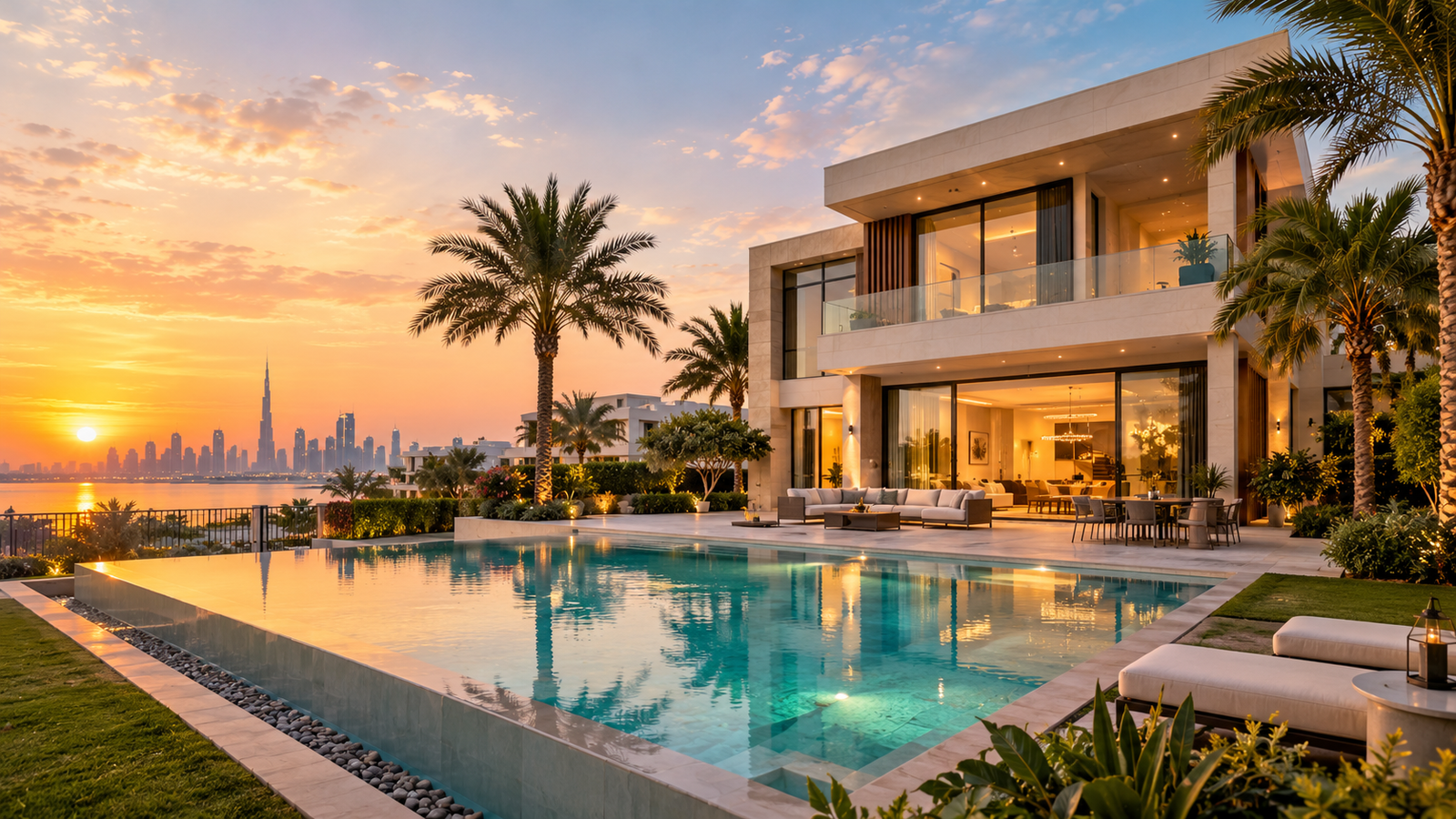
Thinking about how to buy a villa in Dubai? Villas have been the standout performers of Dubai’s property market for five years. Family buyers moving from apartments, international investors and new residents chasing the Golden Visa have pushed villa values far above their previous peak, and despite a cooler market in 2026, demand for good villas in established communities remains solid.
This guide brings together everything you need before you start: current villa prices in Dubai by community and budget, the types of villas on the market, who can buy and where, the step-by-step buying process, the full cost of purchase, mortgages, running costs and the mistakes buyers make most often.
Key takeaways
- Villa prices in Dubai averaged about AED 2,241 per sq ft in the first half of 2026, based on Dubai Land Department transaction data.
- Entry-level villas and townhouses start around AED 1.1–2 million; most family buyers spend AED 2.5–6 million; prime communities start well above AED 10 million.
- Villa values rose about 25.5% in 2025 and are roughly 86% above the 2014 peak. In 2026 the market has cooled, giving buyers more negotiating room.
- Foreigners can buy villas freehold in designated areas, with no UAE residency required.
- Budget around 6–8% on top of the price for transfer fees, agency commission and mortgage costs.
- A villa worth AED 2 million or more can qualify you for the UAE 10-year Golden Visa.
The Dubai villa market in 2026
To understand villa prices in Dubai today, it helps to look at the last few years. According to ValuStrat, freehold villa values in Dubai rose about 25.5% in 2025 alone and were roughly 206% above their 2020 level by the end of the year, and 86% above the previous market peak in 2014. Communities such as Jumeirah Islands, Palm Jumeirah, The Meadows, Victory Heights, Green Community and Mudon led the growth.
2026 has been different. Regional uncertainty from early in the year made buyers more cautious, and Dubai’s overall residential transactions fell by about 38% year on year in Q3 2026, according to Cavendish Maxwell. Average residential prices across all property types were down 1.7% year on year in August 2026, the first annual decline since 2021. S&P Global Ratings estimates prices fell 5–15% between the end of 2025 and September 2026 and expects a gradual rather than sharp correction.
The villa segment has held up better than apartments. Allsopp & Allsopp’s Q3 2026 report shows villa and townhouse transaction volumes up 2% on the previous quarter and total villa transaction value up 17%, driven by strong activity at the top end. Analysts, including S&P, expect apartment prices to come under more pressure than villas because most of the new supply pipeline is apartments: villas and townhouses make up only around a fifth of the homes scheduled for 2026.
What this means for buyers: after years of bidding wars, 2026 is a more balanced market. Sellers of ready villas are more open to negotiation, developers are offering incentives on new launches, and you have more time to compare options.
Villa prices in Dubai by community
The fairest way to compare villa prices across communities is price per square foot, because plot and villa sizes vary so much. The figures below are based on Dubai Land Department transactions from January to June 2026, compiled by Property Monitor, plus October 2026 asking prices for entry-level communities.
| Community | Avg. price per sq ft (AED) | Segment |
|---|---|---|
| Palm Jumeirah | ~8,070 | Ultra-prime |
| Dubai Hills Estate | ~2,896 | Luxury |
| Jumeirah Golf Estates | ~2,524 | Luxury |
| Jumeirah Park | ~2,478 | Luxury |
| Arabian Ranches | ~2,000–2,400 | Premium |
| The Springs | ~2,306 | Premium |
| Tilal Al Ghaf | ~1,940–2,030 | Premium |
| DAMAC Hills | ~1,710–1,910 | Mid-upper |
| Villanova | ~1,435 | Mid-range |
| Town Square | ~1,389 | Mid-range |
| Dubai villa average | ~2,241 | — |
Property Monitor / DLD transaction data, January–June 2026, via Engel & Völkers and VIBGYOR Real Estate. Where two sources differ, a range is shown.
What you can buy at each budget
Under AED 2 million
At this level you are mostly looking at townhouses and compact villas in outer communities: DAMAC Hills 2, Dubailand projects, Sahara Meadows in Dubai Industrial City and parts of Dubai South. Expect 2- to 3-bedroom homes, a small garden and shared community pools. In DAMAC Hills 2, 3-bedroom homes start from around AED 1.35 million, and some Dubailand projects offer 1- and 2-bedroom townhouses from about AED 1.1 million.
AED 2–3.5 million
This is the busiest segment for families and the level at which Golden Visa eligibility starts. Options include 3- and 4-bedroom townhouses and smaller villas in Town Square, Villanova, Dubai South and Emaar South, Arabian Ranches 3, DAMAC Lagoons, The Valley and established Dubailand communities. Many of these are ready, gated communities with schools and retail nearby.
AED 3.5–6 million
Here you move into larger standalone villas in mid-to-upper communities such as DAMAC Hills, Mudon, Al Furjan, Arabian Ranches and Tilal Al Ghaf, or townhouses in central premium communities like The Springs and Dubai Hills Estate. Plots get bigger, and private pools become more common.
AED 6–15 million
Standalone 4- to 6-bedroom villas in Dubai Hills Estate, Jumeirah Park, Jumeirah Golf Estates, The Meadows, Jumeirah Islands and Al Barari. Expect large plots, golf or lake views, high-end finishes and top-tier schools within a short drive.
Above AED 15 million
Prime and ultra-prime: Palm Jumeirah frond villas, Emirates Hills, District One in MBR City and the most exclusive clusters of Jumeirah Golf Estates. In Q3 2026, the top villa deals included Palm Jumeirah villas at AED 55–56 million and a villa in Jumeirah Golf Estates at AED 44 million. Because of these large deals, the average villa sale price in Allsopp & Allsopp’s Q3 2026 data was about AED 8.6 million, well above what a typical family pays.
Types of villas in Dubai
- Standalone (independent) villas: fully detached homes on their own plot, often with space for a private pool. The most expensive option in any community.
- Semi-detached villas: two homes sharing one wall. A middle ground in price and privacy.
- Townhouses: homes built in rows that share one or two walls. Usually 20–40% cheaper than standalone villas in the same community.
- Ready villas: completed homes you can move into or rent out immediately, bought from the current owner (resale) or from the developer.
- Off-plan villas: bought from the developer before or during construction, usually with a payment plan spread over the build period and sometimes after handover.
Can foreigners buy a villa in Dubai?
Yes. Foreign nationals can buy villas with full freehold ownership in designated freehold areas, which cover almost every major villa community, including Dubai Hills Estate, Arabian Ranches, DAMAC Hills, Jumeirah Golf Estates, Palm Jumeirah, Dubailand communities and Dubai South. You do not need a UAE residence visa to buy, and there is no annual property tax.
Freehold means you own the property and the land it stands on outright, with the right to sell, rent out or pass it on. Older central areas such as parts of Jumeirah, Umm Suqeim, Al Barsha and Mirdif are largely reserved for UAE and GCC nationals, though foreigners can rent villas there.
How to buy a villa in Dubai: step by step
Buying a ready (resale) villa
- Arrange financing. If you need a mortgage, get pre-approval first so you know your real budget and can move quickly.
- Choose a RERA-registered agent. Check the agent’s RERA licence and the listing’s DLD permit number.
- View and inspect. Commission a professional snagging or condition survey for older villas (AC, roof waterproofing, plumbing, pool and damp).
- Agree the price and sign the MOU (Form F). Buyer and seller sign a memorandum of understanding, and the buyer usually pays a 10% security deposit.
- Developer NOC. The seller obtains a No Objection Certificate confirming no outstanding service charges.
- Mortgage approval and valuation. If financing, the bank values the villa and issues the final offer.
- Transfer at a DLD trustee office. You pay the transfer fee and balance, and the title deed is issued in your name, usually the same day.
Buying an off-plan villa
- Check the developer and project. Look at the developer’s delivery record and confirm the project is registered with the DLD and has an escrow account.
- Reserve and sign the SPA. You pay a booking amount, then sign the Sales and Purchase Agreement with the payment plan and handover date.
- Register with Oqood. The off-plan purchase is registered with the DLD’s Oqood system, and the 4% registration fee is paid.
- Pay instalments. Payments are made in line with the plan, often linked to construction milestones.
- Handover and title deed. At completion, you inspect the villa, pay the remaining balance and receive the keys and final title deed.
The full cost of buying a villa in Dubai
| Cost | Typical amount | Paid by |
|---|---|---|
| DLD transfer fee | 4% of the price + small admin fees | Buyer (by convention) |
| Registration trustee fee | About AED 4,200 + VAT (properties above AED 500,000) | Buyer |
| Agency commission | About 2% + 5% VAT | Buyer |
| Developer NOC | Varies by developer | Usually seller |
| Mortgage registration | 0.25% of the loan | Buyer |
| Bank valuation | About AED 2,500–3,500 | Buyer |
| Bank arrangement fee | Up to about 1% of the loan | Buyer |
Example: buying a AED 4 million ready villa in cash, expect about AED 160,000 in DLD transfer fees, AED 84,000 in agency commission including VAT and about AED 4,400 for the trustee. That is roughly AED 250,000, or just over 6% of the price. With a mortgage, add registration, valuation and bank fees, bringing the total closer to 7–8%.
Off-plan purchases bought directly from a developer often have no agency commission, and some developers cover part or all of the 4% DLD fee as a launch incentive.
Getting a mortgage for a villa in Dubai
- UAE residents (expats): UAE Central Bank rules allow loans of up to 80% of the value for a first home under AED 5 million, and up to 70% above AED 5 million. UAE nationals can borrow slightly more.
- Non-residents: several UAE banks lend to non-residents, but usually at a lower loan-to-value, often around 50–60%, and with stricter income checks.
- Terms: loans are typically available for up to 25 years, with fixed-rate periods followed by a variable rate linked to EIBOR.
- Off-plan: mortgages are generally only available close to or after handover, so off-plan buyers rely on the developer’s payment plan during construction.
Running costs of owning a villa
The purchase price is only part of the picture. Villa owners in Dubai should budget for:
- Service charges: annual community fees for security, landscaping and shared facilities, charged per square foot and published in the DLD service charge index. They vary a lot between communities.
- DEWA: electricity and water. Cooling a villa through the summer months is the largest variable cost.
- District cooling: some newer communities use a separate cooling provider with its own fees.
- Maintenance: AC servicing, waterproofing, painting and repairs. Budgeting around 1% of the villa’s value a year is a common rule of thumb for older villas.
- Pool and garden: cleaning, chemicals, irrigation and landscaping.
- Home insurance: building and contents cover, required by banks for mortgaged properties.
Golden Visa through a villa purchase
Buying property worth at least AED 2 million can make you eligible for the UAE 10-year Golden Visa, which can also include your spouse and children. The property can be ready, off-plan or mortgaged, subject to conditions set by the authorities. Because many family villas and townhouses in Dubai now cost more than AED 2 million, the Golden Visa has become one of the main reasons international buyers choose a villa over an apartment. Rules can change, so confirm the latest requirements with the Dubai Land Department or GDRFA before you buy.
Is a villa in Dubai a good investment?
Villas in Dubai have historically offered two things investors value: rental demand from families who want space, and stronger capital appreciation than apartments during the recent cycle. Bayut’s H1 2026 data shows projected villa rental yields of around 6% in communities such as DAMAC Hills 2, DAMAC Lagoons and Jumeirah Golf Estates, and around 6.4% in Al Barari. Yields in prime areas tend to be lower, while capital values there have been more resilient.
Points to weigh in 2026:
- New villa rental contracts have softened in several communities as more supply has come to market, so base your plans on current achieved rents, not peak figures.
- Villas carry higher maintenance costs than apartments, which reduces net yield.
- Limited villa supply relative to apartments has supported prices, but large off-plan villa launches in outer areas will add competition over the next few years.
- Location and community quality matter more than ever: well-run, established communities near schools and main roads tend to hold value best.
Common mistakes when buying a villa in Dubai
- Ignoring the commute. A bigger villa far from work and school can cost you hours every week and is harder to resell.
- Skipping the inspection. Older villas can hide AC, plumbing, waterproofing and damp problems that are expensive to fix.
- Underestimating service charges and cooling bills. Check the DLD service charge index and ask for recent DEWA bills.
- Paying above recent transactions. Compare asking prices with actual sales in the same cluster on the DLD website or Dubai REST app.
- Choosing an off-plan project only on price. Developer track record and escrow protection matter more than a small discount.
- Not checking community rules. Extensions, pergolas, pools and holiday-home rentals may need approvals or be restricted.
Frequently asked questions
How much is a villa in Dubai?
Prices range from around AED 1.1–2 million for townhouses and compact villas in outer communities to more than AED 15 million in prime areas such as Palm Jumeirah and Emirates Hills. The average villa price was about AED 2,241 per sq ft in the first half of 2026, and most family buyers spend between AED 2.5 and 6 million.
Can foreigners buy a villa in Dubai?
Yes. Foreigners can buy villas with full freehold ownership in designated freehold areas, which include almost all major villa communities. A UAE residence visa is not required.
What is the cheapest area to buy a villa in Dubai?
The most affordable villas and townhouses are in DAMAC Hills 2, Dubailand projects, Dubai Industrial City and parts of Dubai South, with prices starting at roughly AED 1.1–1.5 million.
What are the extra costs of buying a villa in Dubai?
The main costs are the 4% DLD transfer fee, about 2% agency commission plus VAT and a trustee fee of around AED 4,200 plus VAT. With a mortgage, add 0.25% mortgage registration, valuation and bank fees. In total, budget about 6–8% of the price.
Can I get a mortgage on a villa in Dubai as a non-resident?
Yes, several UAE banks offer mortgages to non-residents, but usually for a lower share of the property value, often around 50–60%, compared with up to 80% for residents buying their first home under AED 5 million.
Does buying a villa in Dubai give you residency?
A property worth at least AED 2 million can qualify the owner for the UAE 10-year Golden Visa, which can include family members. Lower-value properties may qualify for shorter investor visas under certain conditions.
Are villa prices in Dubai going down in 2026?
The overall market has cooled in 2026, with transactions down and average prices slightly lower year on year. Villas have held up better than apartments, and analysts expect apartments to see larger price declines because most new supply is apartments.
Is it better to buy a ready or off-plan villa in Dubai?
Ready villas let you move in or earn rent immediately and can be financed with a mortgage. Off-plan villas usually offer lower entry prices and flexible payment plans but carry construction and delivery risk. The right choice depends on your timeline and how much you can pay up front.
Data sources: Property Monitor / DLD transaction data via Engel & Völkers and VIBGYOR Real Estate (January–June 2026); ValuStrat data via Gulf News (December 2025); Allsopp & Allsopp Q3 2026 Dubai Sales Report; Cavendish Maxwell Q3 2026 data via The National; Cavendish Maxwell August 2026 data via IndexBox; S&P Global Ratings; Bayut H1 2026 market report; Truhauz asking-price survey (October 2026); Alnair buying-costs guide (May 2026). Prices shown are indicative averages and asking prices and may differ from final transaction prices.
Disclaimer: This article is for general information only and does not constitute legal, financial, tax, immigration or real estate advice. Property prices, fees, mortgage rules, visa requirements and market data in Dubai change frequently, and the figures above are indicative averages and asking prices compiled from third-party sources that we do not control or guarantee. Individual properties may be priced differently. While we aim to keep this information accurate and up to date, it may contain errors or omissions. Always verify current prices, fees and rules with the Dubai Land Department (DLD), RERA, your bank or a licensed real estate professional before signing any agreement or making any financial decision. We accept no liability for any loss arising from reliance on this content.