
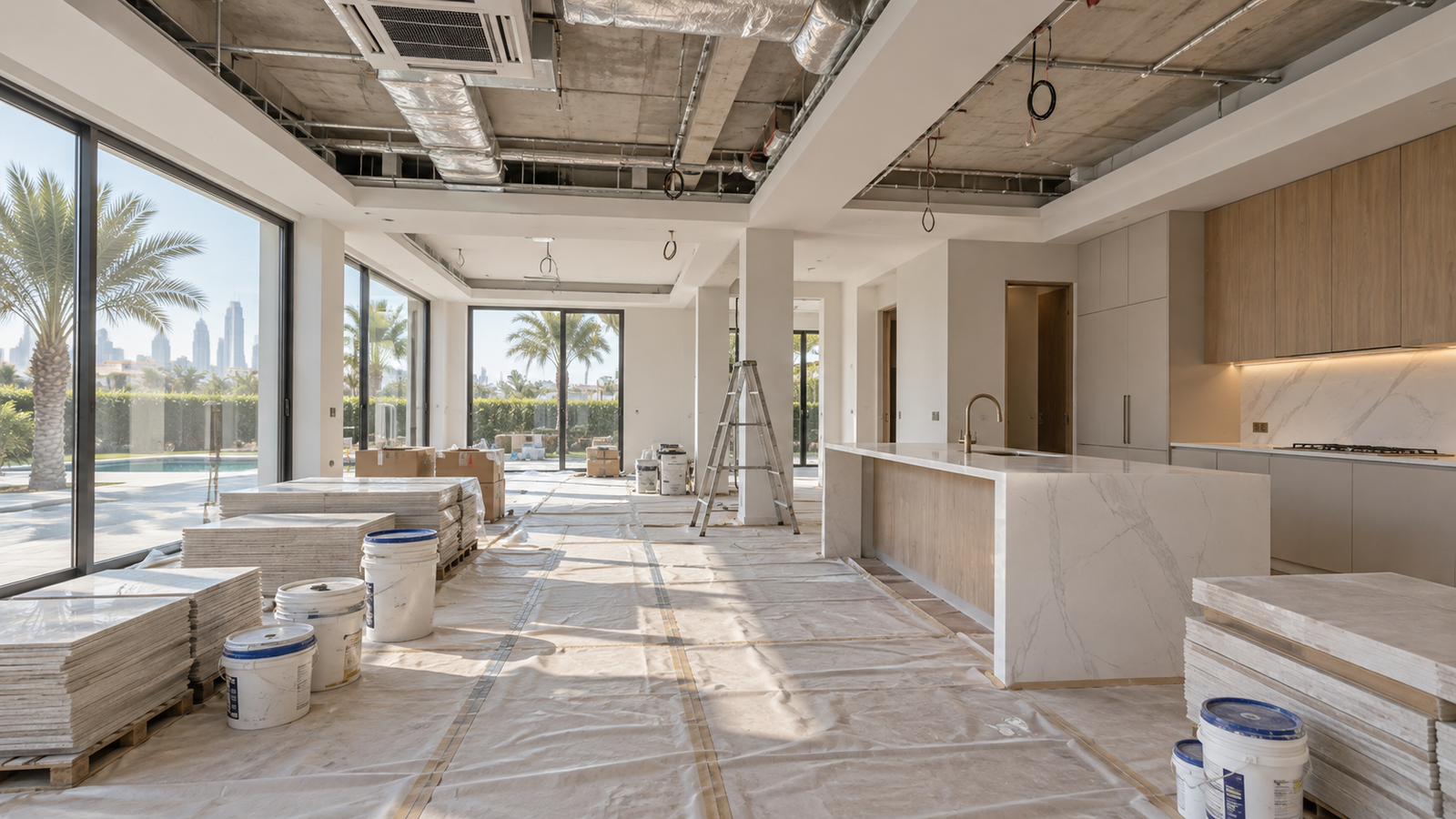
Planning a villa renovation in Dubai? Whether you have just bought an older villa in The Springs or Arabian Ranches, want to modernise a home before renting it out, or are adding a pool or extension, renovation in Dubai follows its own rules. Costs vary enormously by scope and finish, most work needs approval from your developer and often from the authorities, and the climate puts extra demands on air-conditioning, waterproofing and materials.
This guide covers realistic 2026 renovation costs, what each part of the job typically costs, which approvals you need and from whom, how long it takes and how to choose a reliable villa renovation company.
Key takeaways
- A full mid-range renovation of a 3–5 bedroom villa in Dubai typically costs around AED 250,000–850,000. High-end renovations can exceed AED 1.5 million.
- Typical rates range from about AED 150–350 per sq ft for standard to premium finishes, and AED 500–800+ for luxury.
- Kitchens usually cost AED 45,000–200,000, master bathrooms AED 25,000–60,000 and a new pool AED 55,000–250,000.
- Most work beyond painting and like-for-like flooring needs a developer NOC, and layout, MEP, structural and external changes usually need an authority permit too.
- Budget a 10–20% contingency, plus 5% VAT, approval fees and refundable deposits.
- Unauthorised work can lead to fines and can block the sale or refinancing of your villa.
How much does villa renovation cost in Dubai?
Renovation cost depends on three things: the size of the villa, the scope of work and the finish level. The ranges below are planning benchmarks based on 2026 contractor and estimator guides. They are not quotes, and your project could fall outside them.
Cost by renovation level
| Renovation level | What it usually includes | Typical total (AED) | Typical time |
|---|---|---|---|
| Cosmetic refresh | Painting, minor repairs, new fixtures and lighting, some flooring | ~150,000–300,000 (basic repaint and repairs can cost much less) | 2–6 weeks |
| Partial renovation | Kitchen and/or bathrooms, flooring, selected rooms | ~120,000–650,000 | 6–14 weeks |
| Full mid-range renovation (3–5 bed) | All interiors, kitchen, bathrooms, flooring, ceilings, partial MEP upgrade | ~250,000–850,000 | 3–5 months |
| High-end full renovation | Premium materials, layout changes, full MEP, landscaping | ~800,000–1,500,000+ | 4–8 months |
| Luxury, structural or turnkey | Extensions, structural changes, pools, bespoke joinery | ~1,500,000–3,500,000+ | 5–14 months |
Cost per square foot
- Budget / basic: about AED 100–200 per sq ft
- Standard: about AED 150–250 per sq ft
- Premium: about AED 250–400 per sq ft
- Luxury: about AED 500–800+ per sq ft, especially in communities such as Emirates Hills and Palm Jumeirah
Cost by villa size
| Villa | Typical size | Full renovation range (AED) |
|---|---|---|
| 3-bedroom | 2,500–3,500 sq ft | ~150,000–450,000 |
| 4-bedroom | 3,500–5,000 sq ft | ~250,000–750,000 |
| 5-bedroom | 5,000–8,000 sq ft | ~400,000–1,500,000+ |
| 6-bedroom and larger | 7,000+ sq ft | ~500,000–2,000,000+ |
What each part of a villa renovation costs
| Item | Typical cost (AED) |
|---|---|
| Kitchen: budget refresh | ~45,000–80,000 |
| Kitchen: standard custom | ~80,000–120,000 |
| Kitchen: premium with island | ~120,000–200,000+ |
| Master bathroom | ~25,000–60,000 |
| Guest bathroom | ~15,000–35,000 |
| Full villa repainting | ~8,000–25,000 |
| MEP: basic (keep existing) | ~15,000–30,000 |
| MEP: partial upgrade | ~30,000–60,000 |
| MEP: full rewire and replumb | ~60,000–120,000 |
| Landscaping | ~30,000–100,000 |
| New swimming pool | ~55,000–250,000 (a standard 8 x 4 m pool often ~180,000–250,000 all-in) |
| Ground-floor extension (~50 sq m) | ~200,000–300,000, plus extension fees |
Indicative 2026 ranges from Dubai contractor and estimator guides. Excludes VAT, approval fees and deposits unless stated.
Costs that are easy to forget
- 5% VAT on contractor invoices
- Design and engineering drawings: roughly AED 2,500–15,000 for most renovations, more for extensions
- Developer NOC and authority fees (see below)
- Refundable deposits to the developer or community, typically AED 2,000–20,000
- Waste removal and skips, temporary utilities and site protection
- Furniture, appliances and soft furnishings, which are often outside the contractor’s scope
- Alternative accommodation if you cannot live in the villa during works
- Contingency: 10–20% for hidden problems, especially in older villas
Dubai-specific issues to plan for
Dubai’s climate is hard on buildings. In older villas, the most common hidden costs are not in the kitchen but behind the walls and above the ceiling:
- Air-conditioning: old ducted or split systems may need replacing, rebalancing or new ductwork. AC is often the single biggest MEP cost.
- Humidity and condensation: high humidity in summer can cause condensation on ducts and cold surfaces, leading to stained ceilings and mould. Insulation of ducts, proper ventilation and dehumidification should be part of the plan.
- Waterproofing: roofs, terraces, bathrooms and pool areas need effective waterproofing. Failed membranes are a common source of leaks in villas built 15–20 years ago.
- Water tanks and plumbing: older villas may have ageing pipes, low pressure or tanks that need cleaning or replacement.
- Sun and heat: choose UV-resistant exterior paint, heat-reflective glazing and materials rated for high temperatures.
- Termites and pests: check timber, door frames and garden areas before closing up walls.
- Summer working rules: the UAE’s midday outdoor work ban in summer limits outdoor construction hours, which can slow down external works, pools and landscaping between June and mid-September.
Permits and approvals for villa renovation in Dubai
Who approves your renovation depends on where your villa is. In most freehold communities, the process has two layers: the developer or community management first, then the relevant authority for anything beyond minor work.
Which works need approval?
| Type of work | Typical approval |
|---|---|
| Painting, like-for-like flooring, replacing fixtures | Usually no authority permit; often a light NOC or access permit from the community |
| Kitchen or bathroom remodel with plumbing changes | Developer NOC, and commonly an authority permit |
| Removing or adding internal walls | Developer NOC, and commonly an authority permit |
| Moving electrical or AC points, false ceilings near MEP | Developer NOC, and commonly an authority permit |
| Pergolas, shades and garden structures | Developer design approval; size and material rules vary by community |
| Swimming pools | Developer NOC and authority permit, often with a consultant |
| Extensions, structural openings, roof changes, façade changes | Full permit route with a licensed consultant; often restricted |
Who approves what
- Developer or master community (for example Emaar, Nakheel, DAMAC, Meraas): issues the modification or fit-out NOC, sets design rules for the community, takes a refundable deposit and inspects the completed work.
- Dubai Municipality: issues building and modification permits and completion certificates for most mainland villas and many freehold communities.
- Trakhees (PCFC): handles approvals in its zones, including many Nakheel communities such as Palm Jumeirah and Jumeirah Islands.
- Dubai Development Authority (DDA): handles fit-out permits in its own zones.
- Civil Defence and DEWA: may be involved if fire systems are changed or electrical loads are increased.
For villas in older non-freehold areas such as Jumeirah, Umm Suqeim or Al Safa, there is usually no developer layer, and applications go directly to Dubai Municipality through a registered consultant.
Typical fees, deposits and timelines
- Developer NOC fees: commonly quoted at around AED 500–5,000 depending on the developer and scope.
- Refundable deposits: typically AED 2,000–20,000, returned after the final inspection.
- Authority permit fees: commonly AED 500–3,500 for Dubai Municipality modification permits, more for structural work.
- Extension fees: some master developers charge a fee per square foot of new built-up area, which can add significantly to the cost of an extension.
- Timelines: developer NOCs often take one to three weeks and authority reviews another one to two weeks. A standard layout change typically takes three to five weeks end to end; extensions and structural work take two months or more.
Fees and processes change regularly, so ask your contractor or consultant to confirm the current requirements for your community before you sign.
What happens if you renovate without approval
Skipping approvals is a false saving. Depending on the community and authority, unauthorised works can lead to stop-work orders, fines, loss of your deposit and orders to remove the work. Just as importantly, unapproved modifications can block the sale or refinancing of your villa until they are regularised, which often costs far more than getting the permit in the first place.
Community rules to check first
Many communities have strict design guidelines. Examples include limits on how much of the garden a pergola can cover, required materials and colours, pool setbacks and fencing, and restrictions on roof terraces or structures above the parapet. Always ask for the community’s design guidelines before you start designing.
The villa renovation process, step by step
- Define the scope and budget. List what you want to change, set a realistic budget and add a contingency.
- Get an inspection. For older villas, check AC, plumbing, electrics, waterproofing and signs of damp before finalising the design.
- Design. Work with a designer or design-and-build company on layouts, materials and drawings.
- Get quotes. Obtain at least three detailed quotes based on the same scope.
- Apply for approvals. Your contractor or consultant applies for the developer NOC and any authority permits; you sign undertakings and pay deposits.
- Sign a contract. Agree scope, materials, price, payment schedule, timeline, penalties for delay and warranties in writing.
- Construction. Works proceed in stages: demolition, MEP, waterproofing, ceilings, flooring, joinery, finishes.
- Snagging and handover. Inspect everything, list defects and make sure they are fixed before the final payment.
- Completion certificates and deposit refund. Obtain completion certificates and the final NOC, and claim your deposit back.
How to choose a villa renovation company in Dubai
There are hundreds of villa renovation companies in Dubai, from small fit-out firms to large design-and-build contractors. To narrow the list:
- Check the trade licence. The company should hold a valid Dubai trade licence covering contracting or fit-out work, and be registered with the relevant authority for permitted works.
- Ask for insurance. Look for contractor’s all-risk and third-party liability insurance.
- See similar projects. Ask for photos and references from villas in your community or of similar size and age.
- Ask who handles approvals. A good contractor knows your developer’s NOC process and the right authority.
- Compare detailed quotes. Make sure quotes list materials, brands, quantities and exclusions, so you are comparing like with like.
- Agree a staged payment schedule. Avoid paying a large share up front. Link payments to completed stages and keep a retention amount until snagging is finished.
- Get warranties in writing. Ask for warranties on workmanship, waterproofing and installed equipment.
- Clarify who manages the site. Ask who will be your day-to-day project manager and how often you will get updates.
Red flags
- A quote far below all others without a clear explanation
- Pressure to start before approvals are in place
- Requests for most of the payment in advance or in cash
- Vague quotes without materials or quantities
- No trade licence, insurance or verifiable references
Does renovation add value to a Dubai villa?
A well-planned renovation can make a villa easier to sell or rent and can justify a higher price, especially in older communities where unrenovated stock is common. Upgraded villas in established areas such as The Springs, The Meadows and Arabian Ranches regularly list well above unrenovated units of the same type. The renovations that usually pay back best are:
- Modern kitchens and bathrooms
- Efficient, reliable air-conditioning
- Fresh paint, quality flooring and good lighting
- Landscaped gardens and, in premium communities, private pools
- Smart layout changes that open up living space
Very personal or luxury finishes may not be fully recovered when you sell, particularly in mid-range communities. If you are renovating to sell or rent, focus on durability, neutral design and fixing the problems buyers and tenants notice first.
Frequently asked questions
How much does a villa renovation cost in Dubai?
A full mid-range renovation of a 3–5 bedroom villa typically costs around AED 250,000–850,000. A full cosmetic refresh is typically around AED 150,000–300,000 (a basic repaint and minor repairs can cost much less), while high-end and structural renovations can exceed AED 1.5 million.
What is the renovation cost per square foot in Dubai?
Typical rates are about AED 150–250 per sq ft for standard finishes, AED 250–400 for premium and AED 500–800 or more for luxury renovations.
Do I need a permit to renovate my villa in Dubai?
Painting and like-for-like replacements usually do not need an authority permit, though your community may require a basic NOC or access permit. Changes to layout, plumbing, electrical or AC systems, pools, extensions and external works usually need a developer NOC and an authority permit.
How long does a villa renovation take in Dubai?
A cosmetic refresh can take 2–6 weeks, a full interior renovation around 3–5 months and structural or luxury projects 5–14 months, including approvals.
How much does a kitchen renovation cost in a Dubai villa?
Kitchen renovations typically cost about AED 45,000–80,000 for a budget refresh, AED 80,000–120,000 for a standard custom kitchen and AED 120,000–200,000 or more for a premium kitchen with an island.
How much does it cost to build a pool in a Dubai villa?
A new private pool typically costs from around AED 55,000 for a small plunge pool to AED 180,000–250,000 for a standard family pool, plus approval fees.
What happens if I renovate without approval?
You risk stop-work orders, fines, loss of your deposit and orders to remove the work. Unapproved modifications can also block the sale or refinancing of the villa until they are regularised.
How do I choose a villa renovation company in Dubai?
Check the company’s trade licence and insurance, review similar past projects, compare detailed written quotes, confirm who handles approvals and agree a staged payment schedule with warranties in the contract.
Data sources: Bestimate villa renovation cost guide (June 2026) and renovation permit guide (August 2026); First Unicorn Interiors villa renovation cost guide (2026); Dar Al Naseeb villa renovation and extension approval guide (2026). Cost, fee and timeline figures are indicative planning ranges from industry guides and may differ from actual quotes and current official requirements.
Disclaimer: This article is for general information only and does not constitute legal, engineering, financial or construction advice. Renovation costs, permit requirements, fees, timelines and community rules in Dubai change frequently and vary by property, developer and authority. The figures above are indicative ranges compiled from third-party sources that we do not control or guarantee, and companies or communities mentioned are examples only, not recommendations. While we aim to keep this information accurate and up to date, it may contain errors or omissions. Always confirm current requirements with your developer or community management, Dubai Municipality, Trakhees, the Dubai Development Authority or other relevant authority, and obtain written quotes from licensed contractors before starting any work. We accept no liability for any loss arising from reliance on this content.