
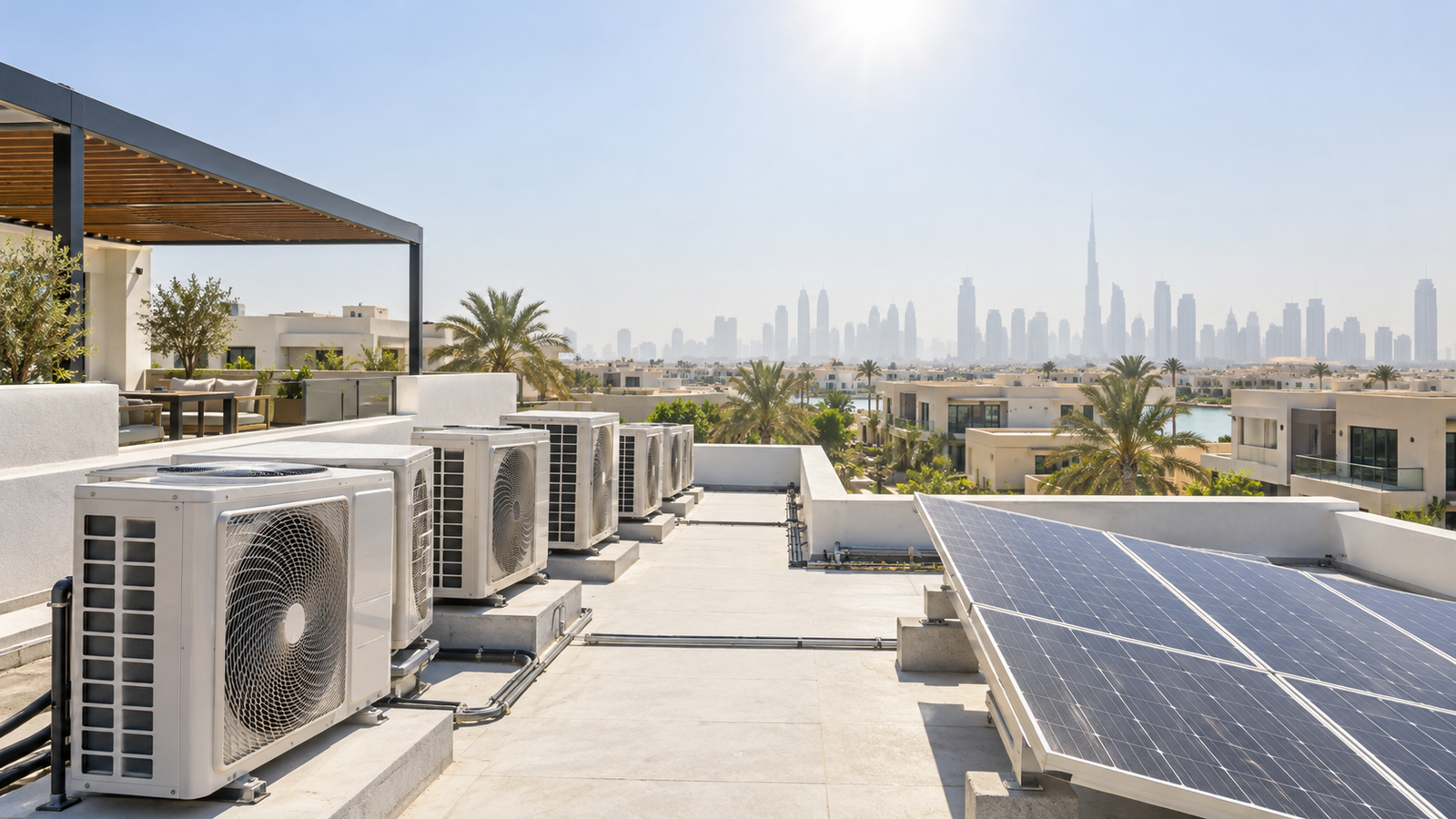
Air conditioning is the single biggest running cost of living in a Dubai villa. With summer temperatures above 45°C and AC running almost around the clock from May to October, a villa’s DEWA bill can be several times higher in July than in January. Some villas also receive a separate chiller bill from a district cooling provider. Understanding how these bills work, and what drives them, can save you thousands of dirhams a year.
This guide explains DEWA tariffs for villas, typical summer and winter bills by villa size, how district cooling (chiller) charges work, other charges on the bill such as the housing fee, and practical ways to cut cooling costs.
Key takeaways
- DEWA charges electricity in rising slabs, from 23 fils per kWh for the first 2,000 kWh a month up to 38 fils above 6,000 kWh, plus a fuel surcharge of around 6–6.5 fils per kWh and 5% VAT.
- A typical 3-bedroom villa might pay around AED 1,200–2,300 a month in summer and AED 400–900 in winter for electricity and water; a 5-bedroom villa can pay AED 2,000–4,000+ in summer.
- For a 4-bedroom villa, average DEWA costs over a year are often around AED 1,200–2,500 a month.
- Most villas have their own AC billed through DEWA. Where a villa uses district cooling, expect a fixed capacity charge (for example, AED 750 per refrigeration ton a year with Empower) plus consumption, often about AED 1,000–1,300 a month for a villa.
- Tenants also pay a housing fee of 5% of annual rent through the DEWA bill, and villa DEWA deposits are about AED 4,000.
How DEWA bills work
The Dubai Electricity and Water Authority (DEWA) supplies electricity and water to most homes in Dubai. A villa’s monthly DEWA bill usually includes:
- Electricity charged by slab, plus a fuel surcharge
- Water charged by slab
- Sewerage fee based on water consumption, collected on behalf of Dubai Municipality
- Housing fee, collected on behalf of Dubai Municipality
- Meter service charges
- 5% VAT on electricity and water charges
DEWA residential electricity tariff
| Monthly consumption | Rate (fils per kWh) |
|---|---|
| 0–2,000 kWh | 23 |
| 2,001–4,000 kWh | 28 |
| 4,001–6,000 kWh | 32 |
| Above 6,000 kWh | 38 |
| Fuel surcharge (all consumption) | ~6–6.5 |
DEWA residential slab tariff as published in 2026 guides. Rates apply to expatriate residential accounts; confirm current rates with DEWA.
Because the rate rises with each slab, large villas that use thousands of kWh in summer pay a higher average price per kWh than apartments. Cutting consumption by even 1,000 kWh a month in summer can save around AED 400–450, including the fuel surcharge.
DEWA residential water tariff
| Monthly consumption | Rate |
|---|---|
| 0–27 m³ (about 6,000 gallons) | AED 7.70 per m³ |
| 27–54 m³ | AED 8.80 per m³ |
| Above 54 m³ | AED 10.12 per m³ |
DEWA residential water slabs as published in 2026 guides. A sewerage fee based on water use is added.
Gardens, irrigation and pools can push villas into the higher water slabs, especially in summer.
Typical DEWA bills for villas
| Villa | Season | Typical electricity use (kWh/month) | Estimated DEWA bill (AED/month) |
|---|---|---|---|
| 3-bedroom | Summer | ~3,500–5,500 | ~1,200–2,300 |
| 3-bedroom | Winter | ~1,200–2,000 | ~400–900 |
| 4-bedroom | Year-round average | — | ~1,200–2,500 |
| 5-bedroom | Summer | ~5,000–8,000+ | ~2,000–4,000+ |
| 5-bedroom | Winter | ~1,800–3,000 | ~600–1,400 |
Indicative ranges from 2026 utility guides and our own calculations using DEWA slab tariffs, including water, sewerage and VAT but excluding the housing fee. Actual bills depend on size, insulation, AC efficiency, thermostat settings, occupancy, garden and pool.
Example: 3-bedroom villa in July
A 3-bedroom villa using 4,500 kWh of electricity and 60 m³ of water in a summer month would pay roughly:
- Electricity: about AED 1,180 for the slabs plus about AED 290 fuel surcharge
- Water: about AED 500
- Sewerage: about AED 200
- VAT and meter charges: about AED 120
That is about AED 2,300 for the month, before the housing fee. In a mild winter month, the same villa might use around 1,500 kWh and 35 m³ of water, for a bill of roughly AED 900.
Annual budget
With five or six hot months and milder months for the rest of the year, many 3-bedroom villas spend roughly AED 15,000–20,000 a year on DEWA, and large 5–6 bedroom villas with pools and big gardens can spend AED 25,000–40,000 or more. Total monthly utilities for a 4-bedroom villa, including DEWA, cooling, internet and gas, are often around AED 1,500–2,500 in winter and AED 4,000–7,000 in summer.
District cooling (chiller) charges for villas
Most villas in Dubai have their own split or ducted AC systems, so cooling simply shows up as electricity on the DEWA bill. Some villas and townhouses, however, are connected to a district cooling network and receive a separate bill from a provider such as Empower, Tabreed or Emicool.
How district cooling bills work
- Capacity (demand) charge: a fixed fee based on the cooling capacity allocated to your home, payable even if you never switch the AC on. Empower charges about AED 750 per refrigeration ton (RT) a year, billed monthly.
- Consumption charge: about AED 0.56–0.57 per RT-hour of cooling used.
- Meter charge and 5% VAT.
- Deposit: about AED 3,000 for a villa with Empower.
| Example | Monthly capacity charge | Summer month | Winter month |
|---|---|---|---|
| Villa, 12 RT (Empower) | ~AED 750 | ~AED 1,265 incl. VAT | ~AED 996 incl. VAT |
Modelled estimate from Real Estate Club Dubai (June 2026). Actual bills depend on allocated capacity and usage.
Because the capacity charge is fixed, 60–80% of a winter chiller bill can be fixed costs. A district-cooled villa still pays DEWA for indoor fan units, lighting, appliances and water.
Chiller-free villas
“Chiller-free” means the landlord pays the district cooling bill. It does not mean free AC: you still pay DEWA for electricity used by fan coil units and everything else. For villas with their own AC, the label makes little difference, as all cooling costs are on the DEWA bill. Always ask a landlord or seller which system the villa uses and for recent bills.
Other charges on the DEWA bill
Housing fee
Tenants pay a housing fee of 5% of the annual rent, collected through the DEWA bill in monthly instalments. On a villa rented for AED 200,000 a year, that adds about AED 833 a month. Owner-occupiers may also see a housing fee on their bill, calculated differently, so check your account details.
Deposits and connection
- Villa security deposit: about AED 4,000, refundable when you close the account
- Activation fee: about AED 110
- District cooling deposit, if applicable: about AED 3,000 for a villa with Empower
What drives a villa’s cooling costs?
- Size and volume: larger villas and double-height spaces need more cooling
- Insulation and glazing: older villas with single glazing and poor roof insulation lose cool air quickly
- Orientation: large west- and south-facing windows increase heat gain
- AC age and efficiency: older or poorly maintained units use much more electricity
- Thermostat settings: each degree cooler adds to consumption
- Occupancy: homes occupied all day use more cooling
- Extras: pool pumps, water heaters, maid’s rooms, garages and outdoor fridges
How to cut cooling costs in a Dubai villa
Quick wins
- Set thermostats to around 24°C and raise them when rooms are empty
- Use smart thermostats and timers to schedule AC; this can save around 15–25% on cooling
- Close curtains and blinds on sun-facing windows during the afternoon
- Cool only the rooms you use and close doors to unused areas
- Use ceiling fans to feel cooler at a higher thermostat setting
Maintenance
- Service AC units before summer and clean filters every one to three months
- Clean ducts and coils, which typically costs about AED 1,200–3,000 for a 3–4 bedroom villa
- Check refrigerant levels and fix leaks
- Seal gaps around doors, windows and ducts
Upgrades
- Replace old AC units with high-efficiency, inverter models with a higher energy-star rating
- Improve roof insulation and use heat-reflective roof coatings
- Install high-performance glazing or window films
- Add external shading such as pergolas, shutters and trees on the west side
- Install rooftop solar: under DEWA’s Shams Dubai programme, villa owners can install solar panels and offset their electricity bills
- Use solar water heaters to cut water-heating costs
- Use drip irrigation to reduce garden water use by around 40–60%
- Use variable-speed pool pumps and timers
Tips for buyers and tenants
- Ask for 12 months of DEWA bills before you rent or buy, to see summer and winter costs
- Check the AC type: split, ducted or district cooling, and its age
- Ask about district cooling capacity charges and outstanding balances
- Check insulation and glazing in older villas
- Include utilities in your budget: in a large villa, summer DEWA bills can rival a month’s rent instalment
- Agree on AC servicing responsibility in your lease
Frequently asked questions
How much is the DEWA bill for a villa in Dubai?
A 3-bedroom villa typically pays around AED 1,200–2,300 a month in summer and AED 400–900 in winter. A 5-bedroom villa can pay AED 2,000–4,000 or more in summer. For a 4-bedroom villa, average DEWA costs across the year are often around AED 1,200–2,500 a month.
What are DEWA electricity rates in 2026?
DEWA’s residential electricity slabs are 23 fils per kWh for the first 2,000 kWh, 28 fils for 2,001–4,000 kWh, 32 fils for 4,001–6,000 kWh and 38 fils above 6,000 kWh, plus a fuel surcharge of around 6–6.5 fils per kWh and 5% VAT.
Do villas in Dubai pay chiller charges?
Most villas have their own AC and pay for cooling through DEWA. Villas connected to district cooling receive a separate bill with a fixed capacity charge and a consumption charge, often around AED 1,000–1,300 a month for a typical villa.
What is the housing fee on a DEWA bill?
The housing fee is 5% of the annual rent, collected through the DEWA bill in monthly instalments on behalf of Dubai Municipality. On a villa rented for AED 200,000 a year, it adds about AED 833 a month.
How much is the DEWA deposit for a villa?
The DEWA security deposit for a villa is about AED 4,000, plus an activation fee of about AED 110. The deposit is refundable when you close the account, minus any unpaid balance.
How can I reduce my villa’s DEWA bill?
Set thermostats to around 24°C, use smart thermostats and timers, service your AC and clean ducts regularly, close blinds in the afternoon, improve insulation and shading, upgrade old AC units and consider rooftop solar through DEWA’s Shams Dubai programme.
Why is my DEWA bill so high in summer?
In summer, AC runs for longer and harder, pushing consumption into higher-priced slabs. Gardens and pools also use more water. Older villas with poor insulation, single glazing or inefficient AC units are particularly affected.
Data sources: DEWA residential slab tariffs as published by Property Finder (February 2026) and other 2026 utility guides; Real Estate Club Dubai guides to utilities and monthly bills (March 2026) and chiller-free vs chiller-paid cooling costs (June 2026); VoltFlow guide to electricity costs in the UAE (April 2026). Example bills are our own estimates based on these tariffs.
Disclaimer: This article is for general information only and does not constitute financial, engineering or legal advice. Utility tariffs, surcharges, fees, deposits and district cooling charges in Dubai are set by DEWA, Dubai Municipality and private cooling providers and may change at any time; the figures above are indicative estimates compiled from third-party sources that we do not control or guarantee. Actual bills depend on the specific property, equipment and usage. This article is not affiliated with or endorsed by DEWA, Empower, Tabreed, Emicool or any other provider mentioned. Always confirm current tariffs and charges directly with DEWA and your cooling provider. While we aim to keep this information accurate and up to date, it may contain errors or omissions. We accept no liability for any loss arising from reliance on this content.