
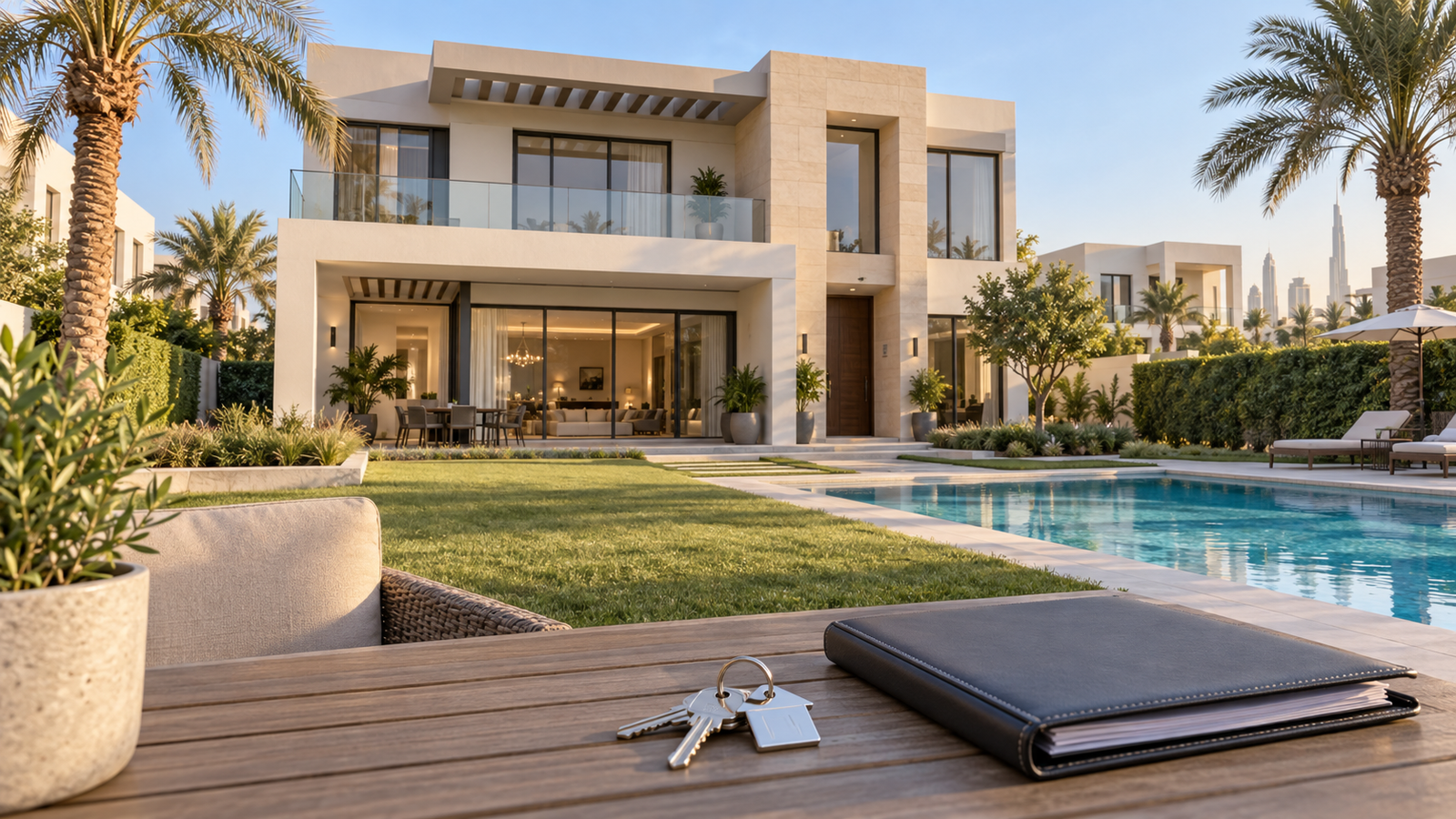
Selling a villa in Dubai is a well-regulated process. Every resale goes through standard Dubai Land Department (DLD) and RERA forms, a developer No Objection Certificate (NOC) and a final transfer at a registration trustee office. The steps are clear, but the costs, paperwork and timeline change a lot depending on whether the villa is mortgaged, tenanted, off-plan or owned through a company. This guide explains how to sell property in Dubai step by step, with a focus on villas and townhouses: what you need, what you pay and how long it takes.
Key takeaways
- The standard route has three steps: Form A (listing agreement with a RERA-licensed broker), Form F (sale agreement or MOU, usually with a 10% deposit), then NOC and transfer at a trustee office.
- Typical seller costs are agency commission of about 2% + 5% VAT, a developer NOC of about AED 500–5,000 and, if mortgaged, an early settlement fee capped at 1% of the balance or AED 10,000, whichever is lower. Market practice is for the buyer to pay the 4% DLD transfer fee, but this is negotiable.
- Expect about 2–4 weeks from signing Form F to transfer for a cash buyer, and about 4–8 weeks or more when the seller’s mortgage must be cleared or the buyer is financing.
- Individuals pay no capital gains tax in Dubai on property resale. Companies and owners taxed in their home country should check their own position.
Before You List: Preparation
1. Check your ownership and documents
Gather the documents buyers, brokers and the trustee will ask for:
- The title deed (or the Oqood registration for an off-plan villa).
- Your passport and Emirates ID, if you are a resident.
- The site plan or affection plan.
- Service charge statements.
- Your mortgage statement, if applicable.
- The tenancy contract and Ejari, if the villa is let.
- Approved modification permits, if you have extended or altered the villa.
- For company-owned property, the trade licence, memorandum of association and board resolution.
2. Settle service charges and check modifications
The developer will not issue an NOC while service charges or community fees are outstanding. Unapproved extensions, pergolas, pools or room conversions can also delay the NOC or cause problems with buyers’ banks and valuers. Clear arrears and gather approvals before you list.
3. Set a realistic price
Price from recent registered transactions of the same villa type, size and position in your community, not from asking prices. Registered sales data is published by the DLD and by the main property portals.
Factors that move a villa’s value most:
- Plot size and position (corner, park- or lake-facing, close to a main road).
- Upgrades and condition, especially AC systems, pools and waterproofing.
- Whether the villa is vacant or tenanted.
An independent RICS valuation is useful for high-value or unusual villas.
Step-by-Step: How to Sell a Villa in Dubai
| Step | What happens | Typical time |
|---|---|---|
| 1. Form A | Listing agreement between the seller and a RERA-licensed broker, setting price, term, commission and exclusivity | Same day |
| 2. Marketing | Broker obtains a DLD advertising permit, lists on portals and arranges viewings | Days to months, depending on price and demand |
| 3. Offer and Form F (MOU) | Sale agreement signed by buyer, seller and brokers; buyer pays a deposit, usually 10% | 1–3 days after the offer is agreed |
| 4. Mortgage clearance (if any) | Seller’s bank issues a liability letter; the loan is settled from the sale proceeds | About 1–4 weeks |
| 5. Developer NOC | Developer confirms no outstanding dues and approves the transfer | About 1–7 working days |
| 6. Transfer at trustee office | Payment by manager’s cheques, DLD fees paid, new title deed issued to the buyer | One appointment, about 1 hour |
| 7. Handover | Keys, access cards, utility (DEWA) closure and transfer, community registration | Same day to a few days |
Standard resale process for a ready villa in Dubai. Timings are indicative.
Step 1: Appoint a broker with Form A
Form A is the RERA listing agreement between you and the brokerage. It records the property, asking price, commission, agreement term and whether the listing is exclusive. Check that the agent and the brokerage are RERA-registered; you can verify this through the DLD’s official apps. An exclusive mandate with one experienced agent often gives better results for a villa than many open listings at different prices.
Step 2: Marketing and viewings
Every advertisement in Dubai needs a DLD advertising permit, issued through the Trakheesi system and shown as a QR code on listings. For villas, professional photos, floor plans, plot and built-up areas, and clear information on upgrades make a real difference. If the villa is let, agree viewing times with the tenant in advance.
Step 3: Agree an offer and sign Form F
Form F, often called the MOU, is the binding sale agreement between buyer and seller. It sets out:
- The price, deposit and completion date.
- Who pays which fees.
- What is included, such as furniture and appliances.
- Conditions, such as the buyer’s mortgage approval.
The buyer usually gives a 10% security deposit, typically a cheque held by the brokerage or in escrow. Under standard terms, if the buyer withdraws without valid cause, the seller usually keeps the deposit. If the seller backs out, the seller may have to return the deposit and pay an equal amount as compensation. Read the default clauses carefully before signing.
Step 4: Clear the mortgage (if applicable)
If your villa is mortgaged, the bank holds the title until the loan is repaid:
- Liability letter. You request one from the bank, showing the exact settlement amount, including the early settlement fee. It usually takes about 5–7 working days and is valid only for a short period, so time it close to the transfer.
- Blocking. With a cash buyer, the parties usually attend a trustee office to “block” the property in the buyer’s favour.
- Loan settlement. The buyer issues a manager’s cheque to your bank for the loan amount.
- Release. The bank closes the loan and releases the mortgage.
- Transfer. The final transfer then takes place.
UAE Central Bank rules cap the early settlement fee at 1% of the outstanding balance or AED 10,000, whichever is lower.
Step 5: Obtain the developer NOC
For freehold communities, the master developer must issue a No Objection Certificate, confirming that service charges and other dues are paid. This applies to developers such as Emaar, Nakheel, DAMAC, Dubai Properties and Meraas. Fees typically range from about AED 500 to AED 5,000 plus VAT, depending on the developer, and the NOC is usually issued within a few working days if the account is clear. NOCs have a limited validity, so the transfer must be booked within that window.
Step 6: Transfer at a trustee office
The buyer and seller, or their representatives under a valid power of attorney, attend a DLD-registered trustee office with:
- Original IDs.
- The NOC.
- The title deed or mortgage release.
- Form F.
- Manager’s cheques for the sale price and fees.
The trustee processes the transfer on the DLD system, and the new title deed is issued electronically in the buyer’s name, usually on the same day.
Step 7: Handover
After transfer, hand over keys, remotes and access cards, and close or transfer your DEWA account; the final bill and deposit refund follow. Update or cancel any district cooling, gas and community registrations, and cancel home insurance from the transfer date.
Costs of Selling a Villa in Dubai
| Cost item | Typical amount | Usually paid by |
|---|---|---|
| Agency commission | About 2% of the sale price + 5% VAT (negotiable) | Seller |
| Developer NOC | About AED 500–5,000 + VAT | Seller |
| DLD transfer fee | 4% of the price + admin fees | Usually buyer (negotiable; can be split) |
| Trustee office fee | AED 4,000 + VAT (price AED 500,000+) | Usually buyer or split |
| Mortgage early settlement fee | Up to 1% of balance, max AED 10,000 | Seller (if mortgaged) |
| Mortgage release and blocking fees at DLD/trustee | Roughly AED 1,000–3,000 in total | Seller (if mortgaged) |
| Outstanding service charges | Whatever is due, up to the transfer date | Seller |
| Capital gains tax | None for individuals in Dubai | — |
Indicative seller and transaction costs for a villa resale in Dubai, 2026. Fee allocation is agreed in Form F.
Example: selling a AED 4 million villa
Take a villa sold for AED 4,000,000, with an outstanding mortgage of AED 1,500,000. In this example the buyer pays the DLD and trustee fees.
- Agency commission: 2% = AED 80,000, + 5% VAT = AED 84,000.
- Developer NOC: about AED 3,000–5,000.
- Early settlement fee: 1% of AED 1.5 million would be AED 15,000, so the AED 10,000 cap applies.
- Mortgage release and blocking fees: about AED 2,000–3,000.
- Total seller costs: roughly AED 99,000–102,000, about 2.5% of the price.
- Net proceeds: about AED 2.4 million after repaying the loan, before any adjustments for prepaid service charges or tax in your home country.
How Long Does It Take?
Once a buyer is found and Form F is signed:
- Cash buyer, no mortgage on the villa: about 2–3 weeks.
- Cash buyer, seller’s mortgage to clear: about 3–5 weeks.
- Buyer with a mortgage: about 4–8 weeks, depending on valuation and bank approval.
- Both sides mortgaged (bank to bank): about 6–10 weeks.
Finding the buyer is the less predictable part. Well-priced family villas in popular communities can sell in weeks, while prime or unusual homes can take months. Common delays include:
- Expired liability letters or NOCs.
- Unapproved modifications.
- Service charge arrears.
- Low bank valuations for the buyer.
- Powers of attorney that are not properly attested.
Special Situations
Selling a tenanted villa
A sale does not end an existing lease. The tenancy transfers with the property, and the buyer takes over as landlord. If the buyer wants vacant possession for their own use, Dubai tenancy law generally requires the owner to give the tenant 12 months’ written notice, served through a notary public or registered mail. An eviction for sale or personal use normally takes effect only once the lease term has ended. Tenanted villas usually appeal to investors, and vacant villas to end users, so this choice affects both price and buyer pool.
Selling an off-plan villa
Off-plan villas can often be resold before handover through an assignment, where the buyer takes over your contract and the remaining payment plan. Many developers allow this only after a minimum share of the price has been paid, often around 30–40%, and charge an assignment or NOC fee. The transfer is registered on the Oqood system. Check your SPA for resale restrictions before you market the villa. This applies to off-plan projects across Dubai, from large master communities to newer Dubailand and Dubai South developments such as Al Waha and The Pulse.
Selling from abroad
Non-resident owners can sell without travelling by appointing a representative under a specific power of attorney for the sale. A POA signed outside the UAE usually has to be notarised, then legalised or apostilled depending on the country, attested by the UAE embassy and the UAE Ministry of Foreign Affairs, and translated into Arabic. Some trustees also accept remote signing options. Sale proceeds can be paid into a UAE account or transferred abroad, as the UAE has no exchange controls.
Company-owned villas and tax
There is no capital gains tax on individuals selling Dubai property. If the villa is held through a company, UAE corporate tax may apply to the gain. Owners who are tax resident elsewhere may also owe tax in their home country. Take advice before you sell.
Golden Visa holders
If your UAE Golden Visa is based on the villa, selling it, or reducing your property holdings below the qualifying AED 2 million threshold, can affect the visa. Check the timing with the immigration authorities before transfer.
Tips to Sell Your Villa Faster and for More
- Price from registered transactions, not from the most optimistic listing in your community.
- Fix the basics. Service the AC, repair waterproofing, clean the pool and tidy the garden. Buyers’ snagging reports quickly turn small issues into price reductions.
- Prepare the paperwork early, including modification approvals, the service charge clearance and your mortgage balance.
- Use professional photography and floor plans, and show the plot size and orientation clearly.
- Be flexible on timing. Vacant possession or a convenient handover date can be worth more than a small price difference.
- Agree fees in writing. Who pays the DLD, trustee and NOC fees should be stated clearly in Form F.
Frequently Asked Questions
How do I sell my property in Dubai?
Appoint a RERA-licensed broker with Form A, market the property with a DLD advertising permit, and agree a sale with a buyer under Form F (MOU) with a deposit of usually 10%. Then clear any mortgage, obtain the developer NOC and complete the transfer at a DLD trustee office, where the new title deed is issued to the buyer.
What are the costs of selling a villa in Dubai?
Typical seller costs are agency commission of about 2% plus VAT, a developer NOC of about AED 500–5,000 and, if mortgaged, an early settlement fee capped at 1% of the balance or AED 10,000, plus mortgage release fees. By market practice the 4% DLD transfer fee is usually paid by the buyer, but it is negotiable.
How long does it take to sell a villa in Dubai?
Once a buyer has signed Form F, a cash sale usually completes in about 2–4 weeks. Sales involving a mortgage on either side typically take about 4–10 weeks. Finding a buyer can take from a few weeks to several months.
Do I pay capital gains tax when selling property in Dubai?
Individuals do not pay capital gains tax in Dubai on property sales. Company-owned property may be subject to UAE corporate tax, and owners may have tax obligations in their home country.
Can I sell my villa in Dubai if it still has a mortgage?
Yes. The bank issues a liability letter with the settlement amount, the loan is repaid from the buyer’s funds via a manager’s cheque, the mortgage is released and the property is then transferred to the buyer.
Can I sell a tenanted villa in Dubai?
Yes. The existing lease transfers to the new owner. If the buyer wants to move in, the tenant generally has to be given 12 months’ notarised or registered-mail notice, which usually takes effect at the end of the lease term.
Data sources: Dubai Land Department and RERA standard forms (Form A, Form F) and fee schedules; UAE Central Bank rules on mortgage early settlement fees; Dubai tenancy law (Law No. 26 of 2007 as amended by Law No. 33 of 2008); seller guides and fee breakdowns published by Dubai brokerages and property portals (2026). Cost examples are editorial illustrations.
Disclaimer: This article is for general information only and does not constitute legal, tax, financial or property advice. Fees, procedures and regulations in Dubai change frequently, and developers, banks and trustee offices may apply different charges and requirements. Figures quoted are indicative and based on information available at the time of writing. Always confirm current requirements with the Dubai Land Department, RERA, your developer, your bank and a RERA-licensed real estate professional, and seek independent legal and tax advice before signing any agreement. The publisher accepts no liability for decisions made based on this content.