
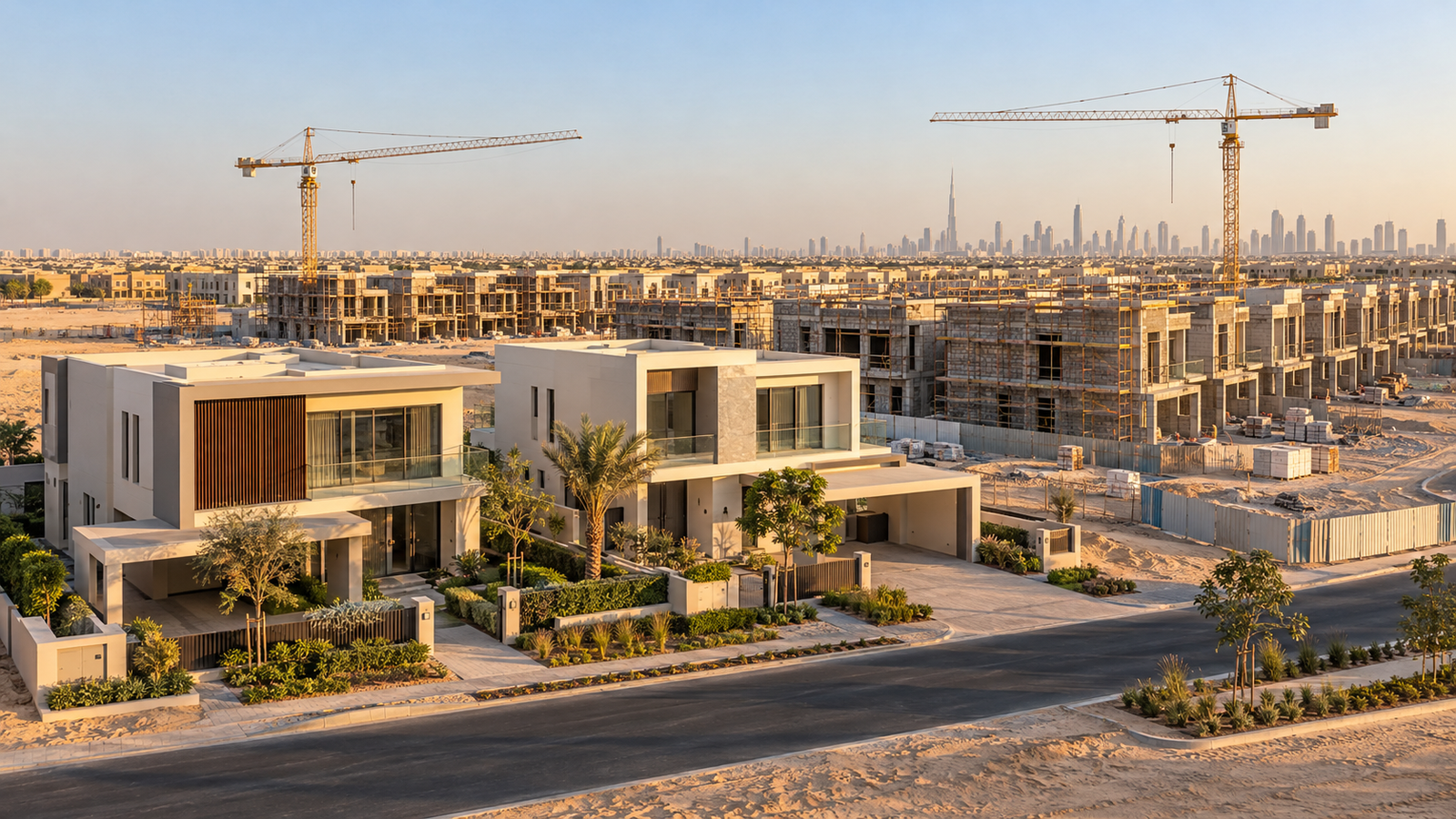
An off-plan townhouse in Dubai or an off-plan villa lets you buy a new home directly from the developer before it is built, usually with a payment plan that spreads the cost over several years. It is the dominant way homes are bought in Dubai today: off-plan properties made up around 72% of purchases and 65% of sales value in Q3 2026.
For villa buyers, off-plan can mean a lower entry price, brand-new specifications and time to save while the home is under construction. It also comes with real risks: delays, changes to the final product, a large handover payment and a market that may look different by the time you get the keys. This guide explains how off-plan villa purchases work in Dubai, typical payment plans, how buyers are protected, the main risks and a selection of notable off-plan villa and townhouse projects in 2026.
Key takeaways
- Off-plan villa payment plans typically start with a 10–20% down payment, with the rest paid during construction and at handover. Common splits are 60/40, 70/30 and 80/20.
- The 4% DLD (Oqood) registration fee is usually due at the start, though some developers cover part or all of it as an incentive.
- Payments are protected by project escrow accounts regulated by the Dubai Land Department and RERA.
- Most sales contracts give developers a 6–12 month grace period beyond the planned completion date before a delay counts as a breach.
- Off-plan villa and townhouse projects in 2026 range from about AED 1 million for compact townhouses to more than AED 20 million for branded villas.
- In 2026, some off-plan investors are reselling contracts before handover, which can create opportunities but also signals pressure in parts of the market.
How buying an off-plan villa in Dubai works
- Choose a project and unit. Review floor plans, the master plan, specifications, handover date and payment plan.
- Reserve the unit. You pay a booking amount, typically 5–20% of the price, and sign a reservation form.
- Sign the Sales and Purchase Agreement (SPA). The SPA sets out the price, payment schedule, completion date, specifications and what happens in case of delay or default.
- Register the sale with Oqood. The purchase is registered on the Dubai Land Department’s interim register for off-plan property, and the 4% registration fee is paid.
- Pay instalments. Payments are made into the project’s escrow account, either on fixed dates or tied to construction milestones.
- Handover. When the project is completed, you inspect the home, pay the handover instalment and any final fees, and receive the keys.
- Title deed. Once all payments are made, the Oqood registration is converted into a full title deed.
Off-plan payment plans explained
| Plan type | How it works | Best for |
|---|---|---|
| 80/20 | 80% paid during construction, 20% at handover | Buyers who want a small final payment |
| 70/30 or 60/40 | Larger share paid at handover | Buyers planning to use a mortgage at completion |
| 50/50 or 40/60 | Half or more of the price due at handover | Buyers who want to keep cash longer, but need strong funding at the end |
| Construction-linked | Instalments tied to building progress | Buyers who want payments to follow actual construction |
| Post-handover | Part of the price paid over 1–5 years after you receive the keys | Buyers who want to rent out the home and use rent to pay instalments |
A typical structure might be 10–20% on booking, 40–60% in instalments during construction and 20–50% at handover. For example, one 2026 townhouse project in Dubailand uses a 20% down payment, 55% during construction and 25% at handover; another in Jumeirah Golf Estates uses 10% on booking, 70% during construction and 20% at handover.
Planning for the handover payment
The handover payment is where many off-plan buyers run into trouble. If you plan to pay it with a mortgage, the bank will value the property at handover, and if the valuation is lower than your purchase price, you will need to cover the gap in cash. UAE residents can typically borrow up to 80% of the value for a first home under AED 5 million, but banks generally do not lend on off-plan property until it is close to completion.
Costs of buying off-plan
- Oqood / DLD registration: 4% of the purchase price, usually paid at the start. Some developers waive part or all of it during launches.
- DLD admin and developer fees: smaller fixed fees for registration and paperwork.
- Agency commission: often nil when buying directly from the developer; if an agent is involved, the developer usually pays the commission on new launches.
- Handover costs: utility connections, the first year’s service charge and, if financing, mortgage registration (0.25% of the loan), valuation and bank fees.
- Title deed issuance: a small fee when the Oqood registration is converted into a title deed.
How off-plan buyers are protected in Dubai
Dubai has one of the more developed legal frameworks for off-plan property in the region:
- Escrow accounts (Law No. 8 of 2007): buyers’ payments go into a dedicated escrow account for each project, managed by an approved bank and supervised by the DLD. Developers can only draw money as construction progresses. A share of the funds is retained for a year after completion to cover defects.
- Project registration: developers must register projects and obtain approvals before selling. Every unit sale is recorded on the Oqood system.
- Cancelled projects: if RERA formally cancels a project, buyers are entitled to a refund of the amounts paid, prioritised from the project’s escrow account.
- Buyer default rules (Law No. 13 of 2008, as amended): if a buyer stops paying, the developer must follow a formal process before terminating. Depending on how far construction has progressed, the developer may be allowed to retain part of what was paid, commonly cited as up to 25% where the project is less than 60% complete and up to 40% where it is further advanced.
- Defects: developers are usually responsible for fixing defects during the first year after handover, and contractors and engineers carry ten-year liability for structural defects.
- Disputes: buyers can use DLD mediation, the courts and, for cancelled projects, a dedicated tribunal.
These protections reduce but do not remove the risk of buying off-plan. Read your SPA carefully, and consider having a lawyer review it before signing.
Risks of buying an off-plan villa or townhouse
- Delays: handover dates frequently slip. Most SPAs allow a 6–12 month grace period before a delay counts as a breach, and compensation is usually limited to what the contract specifies or what you can prove as direct loss.
- Changes to the product: final layouts, finishes, views and community facilities can differ from brochures. Check what the SPA actually guarantees.
- Market risk: prices may fall between purchase and handover. S&P Global Ratings estimated a 5–15% decline in Dubai prices between the end of 2025 and September 2026 and expects heavy supply to keep pressure on apartments in particular.
- Handover funding: a large final payment combined with a low bank valuation can leave you short of cash.
- Resale restrictions: many developers only allow you to sell (assign) your contract after a certain share of the price has been paid, and may charge a transfer fee.
- Competition at handover: if many investors in the same project try to rent or sell at the same time, rents and resale prices can be pushed down.
- Service charges: once the project is complete, service charges apply. Ask the developer for an estimate.
Off-plan vs ready villa: which is better?
| Off-plan | Ready | |
|---|---|---|
| Entry cost | 10–20% down plus 4% DLD fee | Full price (or 20%+ deposit with mortgage) plus fees |
| Payment | Spread over construction and sometimes after handover | Paid at transfer |
| Product | New build, modern specification, may change before handover | What you see is what you get |
| Income | None until handover | Rent from day one |
| Risk | Delays, construction and market risk | Condition and maintenance risk |
| Financing | Mostly developer payment plans | Standard UAE mortgages |
Off-plan suits buyers who can wait two to four years, want to spread payments and value a brand-new home. Ready villas suit buyers who need to move in or earn rent now, or who want to avoid construction risk.
Notable off-plan villa and townhouse projects in Dubai (2026)
The projects below are examples of what is on the market in 2026, from entry-level townhouses to luxury villas. Prices are starting prices reported by developers and agents and can change quickly. Availability, payment plans and handover dates should always be confirmed with the developer.
Entry level: around AED 1–2.5 million
- Verdana, Dubai Investment Park: compact 1-bedroom townhouses, with resales of off-plan contracts listed from around AED 800,000–1,000,000 and handover from late 2026.
- Reportage Village, Dubailand: 1- and 2-bedroom townhouses from around AED 1.0–1.2 million, with an 80/20 payment plan and handover expected around Q4 2027.
- DAMAC Lagoons (for example, Malta cluster): themed townhouse clusters from around AED 1.75 million.
- DAMAC Sun City: 4-bedroom townhouses from around AED 2.25 million.
Mid-range: around AED 2.5–4 million
- DAMAC Islands 2, Dubailand: 4-bedroom townhouses from around AED 2.75 million, with a 20/55/25 payment plan and handover planned for Q3 2029.
- Reportage Hills, Dubailand: townhouses from around AED 2.77 million, with flexible plan options and handover planned for Q4 2028.
- The Valley phases by Emaar: townhouses from around AED 3.1 million on an 80/20 plan, with twin villas in newer phases such as Alana from around AED 3.5 million.
- La Tilia, Villanova: the final Villanova cluster by Dubai Properties, with 3- and 4-bedroom homes resold off-plan at around AED 3.2–3.7 million and handover expected around 2028.
Premium and luxury: AED 6 million and above
- Pinewood Estate Homes, Jumeirah Golf Estates (Wasl): from around AED 6.1 million, with a 10/70/20 plan and handover planned for Q4 2028.
- Nad Al Sheba Gardens (Meraas): townhouses and villas near Meydan from around AED 6.15 million, on an 80/20 plan with handover planned for Q2 2029.
- Alaya, Tilal Al Ghaf: villas from around AED 6.8 million, with Alaya Gardens from around AED 8.5 million.
- Park Gate Villas, Dubai Hills Estate: from around AED 10.4 million.
- Address Villas Hillcrest, Dubai Hills Estate: branded 5-bedroom villas from around AED 23 million.
Off-plan resales: buying before handover
You do not have to buy off-plan directly from the developer. Investors who bought at launch often sell (assign) their contracts before completion. In 2026, with a slower market, some investors facing large handover payments have been offering contracts below current launch prices, and sometimes below the original purchase price.
Off-plan resales can be good value, but check:
- How much the seller has paid and how much is still due, and when
- The developer’s statement of account and confirmation that instalments are up to date
- Whether the developer allows the transfer and what it charges
- That the Oqood registration will be transferred to your name
- That the price is genuinely below comparable new and resale units, not just below the original launch price
How to choose an off-plan villa project
- Developer track record: look at past projects. Were they delivered on time, and does the finished quality match the brochures?
- Project registration: confirm the project is registered with the DLD and has an escrow account. Ask for the escrow account details and make payments only to that account.
- Location fundamentals: roads, schools, retail and employment hubs that already exist matter more than promises of future infrastructure.
- Supply around the project: large numbers of similar units handing over at the same time can weigh on rents and resale prices.
- Payment plan fit: make sure you can comfortably meet every instalment, including the handover payment, even if your circumstances change.
- SPA terms: check the completion date, grace period, delay compensation, specification list and default clauses.
- Exit options: find out when you are allowed to resell the contract and at what cost.
- Service charges: ask for an estimate per square foot.
Golden Visa and off-plan property
Off-plan property can count towards the UAE 10-year Golden Visa if the total value is at least AED 2 million, subject to the conditions set by the authorities, which can include a minimum amount already paid. Requirements change, so check the latest rules with the DLD or GDRFA before you rely on an off-plan purchase for residency.
Frequently asked questions
What is an off-plan townhouse in Dubai?
It is a townhouse bought directly from the developer before or during construction, usually with a payment plan that spreads the price over the build period and sometimes after handover.
How much deposit do I need for an off-plan villa in Dubai?
Most developers ask for 10–20% of the price as a down payment, plus the 4% DLD registration fee. Some launches offer lower down payments or cover part of the DLD fee.
Is it safe to buy off-plan property in Dubai?
Dubai has strong protections, including mandatory escrow accounts, DLD project registration and refund rights if a project is cancelled. However, delays, market changes and handover funding remain real risks, so choose established developers and read the SPA carefully.
What happens if an off-plan project in Dubai is delayed?
Most SPAs allow a grace period of 6–12 months. After that, buyers may be entitled to compensation as set out in the contract or for proven direct losses, and disputes can go to DLD mediation or the courts.
What happens if a project is cancelled?
If RERA formally cancels a project, buyers are entitled to a refund of the amounts paid, prioritised from the project’s escrow account, through a dedicated legal process.
Can I sell my off-plan villa before handover?
Yes, usually, but many developers only allow resale after a set share of the price has been paid and may charge a transfer fee. Check your SPA and the developer’s policy.
Can I get a mortgage on an off-plan villa?
Most buyers rely on the developer’s payment plan during construction. UAE banks generally lend on off-plan property only close to or at handover, based on the bank’s valuation at that time.
What is the cheapest off-plan townhouse in Dubai?
Compact 1-bedroom townhouses in Dubai Investment Park and Dubailand projects such as Reportage Village start from around AED 0.8–1.2 million. Family-size 3- and 4-bedroom off-plan townhouses typically start from around AED 1.75–2.75 million in DAMAC communities and Dubailand.
Data sources: Cavendish Maxwell Q3 2026 data via The National; Driven Properties off-plan projects guide (October 2026); Siraj Sultanli townhouse projects guide (updated June 2026); Property Finder listings (October 2026); APIL Properties market survey; Truhauz market survey (October 2026); Villanova resale data (July 2026); Bayut Dubai Hills Estate data (October 2026); Khaleej Times guide to off-plan cancellation and refund rules; Neo Legal guide to off-plan delays and defects (July 2026); S&P Global Ratings. Prices are starting prices reported by developers and agents and may change at any time.
Disclaimer: This article is for general information only and does not constitute legal, financial, tax, immigration or real estate advice, and nothing in it is a recommendation to buy any specific project. Off-plan prices, payment plans, handover dates, fees, laws and visa rules in Dubai change frequently, and the project details above are indicative information compiled from third-party sources that we do not control or guarantee. This article is not affiliated with or endorsed by any developer mentioned. Summaries of laws are simplified and may not reflect the latest amendments or how they apply to your contract. While we aim to keep this information accurate and up to date, it may contain errors or omissions. Always verify project registration, escrow details, prices and contract terms with the Dubai Land Department (DLD), RERA, the developer, a licensed real estate professional or a qualified lawyer before signing any agreement or making any payment. We accept no liability for any loss arising from reliance on this content.