
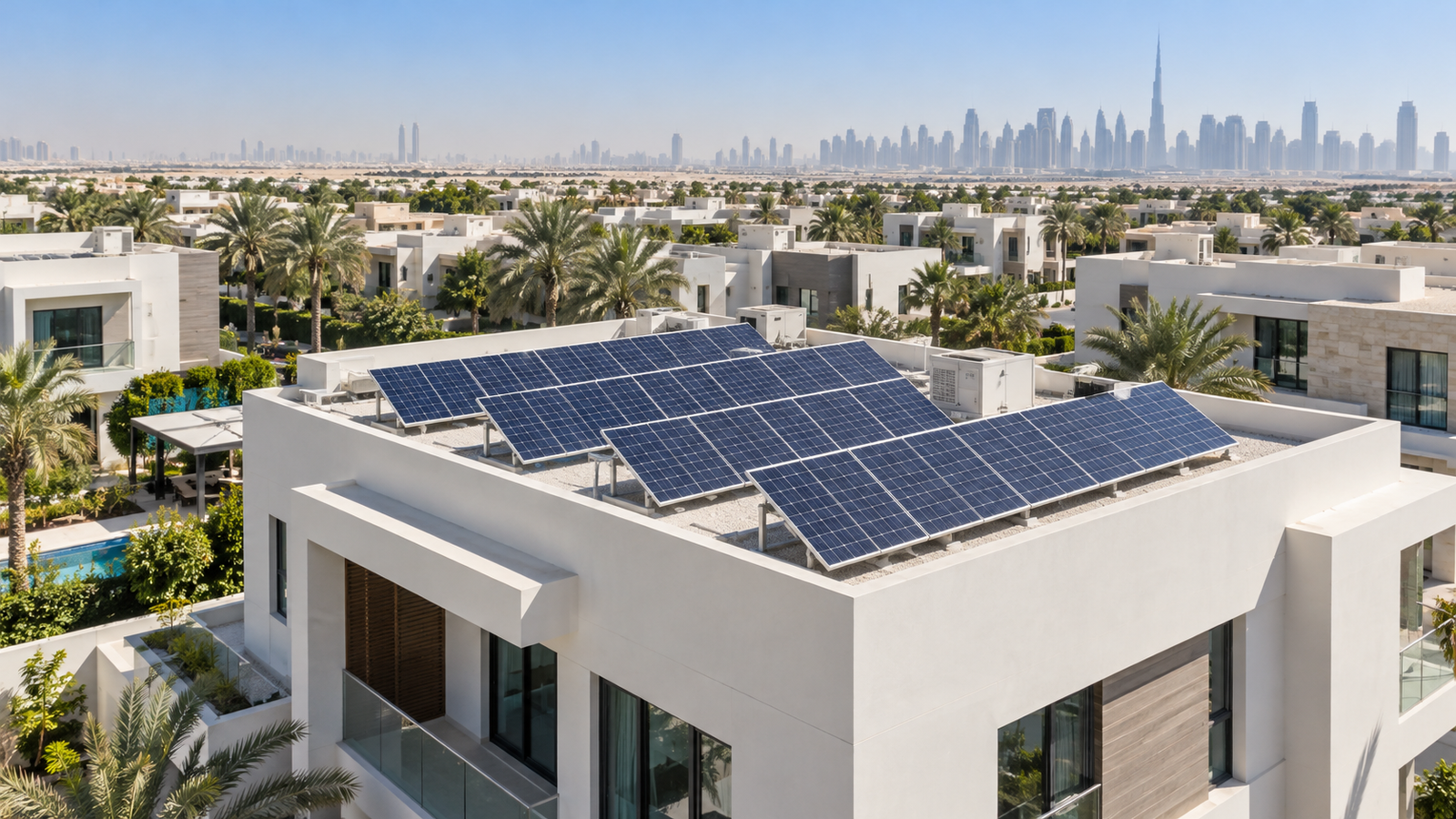
Dubai gets roughly 2,800 or more hours of sunshine a year, and villas often run very large electricity bills in summer. That makes a rooftop solar system one of the more practical upgrades a villa owner can consider. Under DEWA’s Shams Dubai programme, homeowners can install solar panels on their roof, connect them to the grid and use any surplus to offset future bills. This guide explains how Shams Dubai works for villas, what solar panels for a villa in Dubai cost in 2026, how long payback takes, and what to check before you install.
Key takeaways
- How Shams Dubai works: Solar power is used in the villa first. Surplus goes to the DEWA grid and is credited against future consumption through a bidirectional meter. DEWA does not pay cash for exported power.
- System size and cost: Typical villa systems are 5–20 kWp. Installed prices are about AED 22,000–30,000 for 5 kW and AED 40,000–55,000 for 10 kW.
- Output and payback: Each kWp produces roughly 1,500–1,650 kWh a year in Dubai. Payback is often about 6–10 years, depending on system cost, which DEWA tariff slab you offset and how well the panels are kept clean.
- Approvals: Installation requires a DEWA-accredited contractor, DEWA approvals and inspection, and usually a developer or community NOC. Allow about 6–12 weeks in total.
What Is Shams Dubai?
Shams Dubai is DEWA’s distributed renewable energy programme. It has been open to homes and businesses since 2015 and allows owners to generate electricity from solar panels on their own buildings.
- Panels on the roof produce electricity during the day.
- The villa uses that electricity first, reducing the power drawn from the grid.
- When the panels produce more than the villa uses, the surplus is exported to the DEWA grid.
- A bidirectional meter records both imports and exports. Exported units are credited against the electricity you use from the grid, for example at night or in later months.
Under the current rules:
- Credits carry forward on the account.
- Credits cannot be paid out in cash or transferred to another account.
- Solar only offsets the electricity part of the bill. Water, sewerage, the municipality housing fee and fixed charges still apply.
DEWA has updated the programme several times, so confirm the latest rules with DEWA or your contractor before you commit.
How DEWA Tariffs Affect Solar Savings
DEWA charges residential electricity on an increasing slab tariff, and a fuel surcharge is added on top of the base rate.
| Monthly consumption (kWh) | Base rate (fils/kWh) | Approx. total with fuel surcharge (fils/kWh) |
|---|---|---|
| 0 – 2,000 | 23 | ~29–30 |
| 2,001 – 4,000 | 28 | ~34–35 |
| 4,001 – 6,000 | 32 | ~38–39 |
| Above 6,000 | 38 | ~44–45 |
DEWA residential electricity slab tariff (indicative). The fuel surcharge can change; check DEWA’s current rates.
A large villa in Dubai can easily use 4,000–8,000 kWh a month or more in summer, mainly for air conditioning, pool chillers and pumps. Solar first reduces the most expensive units at the top of the slab structure, so villas with high consumption see the best savings per kWh. A small townhouse that stays in the lowest slab saves less per kWh, so payback takes longer.
How Much Do Solar Panels Cost for a Villa in Dubai?
| System size | Typical villa | Approx. roof area needed | Indicative installed cost (AED) | Approx. annual output (kWh) |
|---|---|---|---|---|
| 5 kWp | Townhouse / small villa | ~25–35 sq m | 22,000 – 30,000 | 7,500 – 8,250 |
| 7–8 kWp | 3–4 bed villa | ~35–50 sq m | 30,000 – 44,000 | 10,500 – 13,000 |
| 10 kWp | 4–5 bed villa | ~50–65 sq m | 40,000 – 55,000 | 15,000 – 16,500 |
| 15–20 kWp | Large villa with pool | ~75–130 sq m | 60,000 – 100,000 | 22,500 – 33,000 |
Indicative 2026 costs and output for grid-connected rooftop solar on Dubai villas. These are editorial estimates based on published installer ranges; actual quotes depend on panels, inverter, roof structure and installer.
Costs usually include:
- Panels, inverter and mounting structure.
- Cabling and protection equipment.
- Design and DEWA submission.
- Installation and commissioning.
DEWA connection and meter charges and any developer NOC fees may be separate. Smaller systems usually cost more per kWp than larger ones.
Batteries
Under Shams Dubai, the grid effectively acts as your “battery” through credits, so most villa systems in Dubai are installed without batteries. Battery storage adds substantially to the cost and lengthens payback. It mainly makes sense if you want backup power during outages or for specific off-grid uses.
Payback: Worked Example
Take a 4–5 bedroom villa that installs a 10 kWp system for about AED 48,000:
- Annual output: about 15,500 kWh. That is about 1,550 kWh per kWp, allowing for heat losses and dust.
- Savings if the solar offsets top-slab units at about 38–44 fils/kWh: about AED 5,900–6,800 a year.
- Savings if it offsets low-slab units at about 29–30 fils/kWh: about AED 4,500–4,650 a year.
- Simple payback: about 7–8 years for a high-consumption villa, and about 10–11 years for a lower-consumption home.
Payback is shorter if the system costs less, if tariffs or fuel surcharges rise, or if the panels are cleaned regularly. It is longer if the roof is shaded, dust builds up, or the inverter needs replacing during the period.
Panels typically come with 25-year performance warranties, so a well-maintained system can keep producing savings for many years after payback.
How to Install Solar Panels on a Dubai Villa
- Check eligibility and community rules. Ask your master developer or community management whether rooftop solar is allowed, and which NOC or design guidelines apply. Many communities have rules on panel placement, visibility and roof loading.
- Choose a DEWA-accredited contractor. Only DEWA-enrolled consultants and contractors can design and install Shams Dubai systems. Compare at least two or three quotes.
- Site survey and design. The contractor assesses roof space, orientation, shading and your DEWA consumption history, then designs a system. It should use panels and inverters on DEWA’s approved equipment list.
- DEWA application and approval. The contractor submits the application and design for DEWA approval through DEWA’s systems. This typically takes a few weeks.
- Installation. Installing a residential system usually takes about 3–7 working days once approvals are in place.
- Inspection and meter. DEWA inspects the system, installs a bidirectional meter and connects it to the grid. The system must not export power before DEWA authorises it.
Total time from first quote to connection is typically about 6–12 weeks, depending on approvals and any design revisions.
Is Your Villa Suitable for Solar?
- Roof space and orientation. Flat roofs are common in Dubai and work well with tilted mounting frames. Pitched roofs facing south, east or west also work.
- Shading. Water tanks, AC units, parapets, neighbouring buildings and trees can reduce output. Good design works around them.
- Roof condition. Repair or redo waterproofing before installation, as removing panels later adds cost.
- Consumption. High summer bills from AC, pool chillers and large households improve the economics.
- Ownership. As a tenant, you would need the landlord’s written consent, and the system stays with the villa. Solar mainly suits owners who plan to stay several years.
- Community type. Standalone villas usually have more usable roof space than compact townhouses. In newer townhouse projects across Dubailand and Dubai South, such as Al Waha and The Pulse, check roof space and developer rules first.
Maintenance and Cleaning
Dust is the main enemy of solar output in Dubai. Uncleaned panels can lose a noticeable share of their production within weeks, especially after sandstorms. Typical maintenance includes:
- Panel cleaning: Every 2–4 weeks in dusty periods, using soft brushes and water, or a professional cleaning service. Avoid abrasive tools and harsh chemicals.
- Monitoring: Check output in the inverter app regularly to spot drops in performance.
- Annual inspection: Check mounting, cabling, connectors and inverter ventilation.
- Inverter replacement: Inverters often need replacing once during the system’s life, typically after about 10–15 years.
Many installers offer annual maintenance and cleaning packages. Include their cost in your payback calculation.
Pros and Cons of Solar for Dubai Villas
Advantages
- Lower electricity bills, especially for high-consumption villas.
- Strong, reliable sunshine for most of the year.
- Credits carry forward, so surplus spring and winter output can offset summer use.
- Panels shade the roof, which can slightly reduce heat gain.
- Supports Dubai’s clean energy goals and can appeal to eco-conscious buyers and tenants.
Drawbacks
- Upfront cost of tens of thousands of dirhams.
- No cash payment for surplus power.
- Regular cleaning needed because of dust.
- Approvals from DEWA and the developer take time.
- Limited roof space on many townhouses.
- Limited value if you plan to sell or move soon, as credits cannot be transferred.
Frequently Asked Questions
How much do solar panels cost for a villa in Dubai?
Installed grid-connected systems typically cost about AED 22,000–30,000 for 5 kW and AED 40,000–55,000 for 10 kW. Large villas with 15–20 kW systems may pay about AED 60,000–100,000, depending on equipment and installer.
How does Shams Dubai work?
Under Shams Dubai, solar electricity is used in the villa first, and any surplus is exported to the DEWA grid through a bidirectional meter. Exported units are credited against future electricity consumption. DEWA does not pay cash for surplus power.
What is the payback period for solar panels in Dubai?
Payback is often about 6–10 years. It is shorter for high-consumption villas that offset expensive top-slab units, and longer for smaller homes in the lowest tariff slab.
How much electricity does a solar panel system produce in Dubai?
Each kWp of panels typically produces about 1,500–1,650 kWh a year in Dubai, depending on orientation, shading, temperature and cleaning. A 10 kWp system produces roughly 15,000–16,500 kWh a year.
Do I need approval to install solar panels on my villa in Dubai?
Yes. The system must be designed and installed by a DEWA-accredited contractor, approved and inspected by DEWA, and connected through a bidirectional meter. Most communities also require a developer or community NOC.
Can solar panels reduce my DEWA bill to zero?
Not usually. Solar can offset much or even all of your electricity consumption, but water charges, the municipality housing fee and fixed charges on the DEWA bill still apply.
Data sources: DEWA Shams Dubai programme information and residential slab tariff; published guides on Shams Dubai regulations and residential solar costs in Dubai (2024–2026). System costs, output and payback figures marked as indicative are editorial estimates based on these sources.
Disclaimer: This article is for general information only and does not constitute financial, technical or legal advice. DEWA rules, tariffs, fuel surcharges, approval procedures and installer prices change, and figures quoted are indicative and based on information available at the time of writing. Actual output and savings depend on your roof, consumption, equipment and maintenance. Always confirm current requirements with DEWA, your developer or community management and a DEWA-accredited contractor, and obtain several written quotes before installing a solar system. The publisher accepts no liability for decisions made based on this content.