
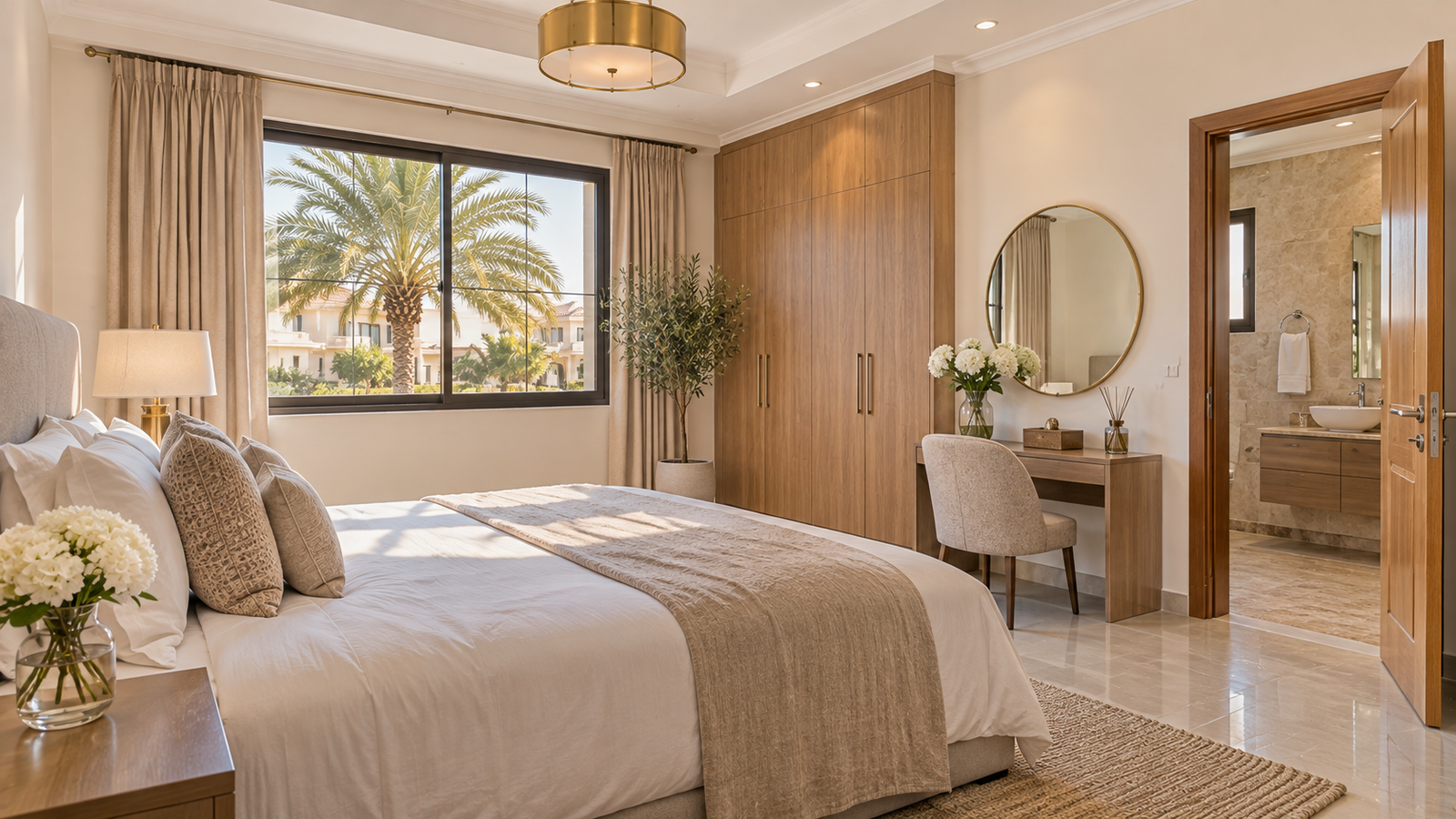
For years, renting a room in a villa was one of the cheapest ways to live in Dubai. A family room with an attached bathroom in Al Qusais, a partition in Satwa or a bedspace in an old Rashidiya villa often cost a fraction of a full apartment. In 2026 the rules changed. Dubai’s new shared housing law, Law No. 4 of 2026, now sets out exactly who may rent out shared accommodation, where, and to whom. Penalties reach AED 500,000, and up to AED 1 million for repeat violations. If you are looking for a room for rent in a villa in Dubai, this guide explains what is legal now, what typical prices look like, and how to check a room before you pay a deposit.
Key takeaways
- Law No. 4 of 2026 regulates shared housing in Dubai. It was published in February 2026 and took effect in late August 2026. Existing operators have a one-year grace period to comply, ending around late August or early September 2027.
- Shared housing now needs a Dubai Municipality permit and must be in an approved area. More than 44 areas have been approved so far, including Al Barsha 1, Al Warqa 1, Al Rigga, Al Muraqqabat, Al Ras and Al Souq Al Kabeer.
- Only the property owner or a licensed operator may rent out rooms. Tenants may not sublet rooms, partitions or bedspaces.
- Families and individuals cannot share the same unit. In family sharing, each family needs its own bedroom with an en-suite bathroom.
- Minimum standards include 5 sq m of bedroom space per person and one full bathroom per four residents. Partitions made of wood or non-fire-rated gypsum board are not allowed without a permit.
- Fines range from AED 500 to AED 500,000 and can double, up to AED 1 million, for repeat violations within a year.
Why Dubai Introduced a Shared Housing Law
Dubai’s rapid population growth and high rents pushed many residents into informal shared housing. Villas and apartments were divided with partitions, rooms were sublet through social media and WhatsApp groups, and some properties housed far more people than they were designed for. A fire in June 2025 in a Dubai Marina tower where thousands of people were living exposed the dangers of illegal partitions. Inspections and evictions from illegally partitioned units increased afterwards.
Law No. 4 of 2026, “Regulating the Occupancy and Management of Shared Housing in the Emirate of Dubai”, replaces this grey area with a permit system. It does not ban shared living. Instead, it sets out where it is allowed, who may operate it and what standards it must meet. Dubai Municipality then issued a circular with detailed planning, building and occupancy requirements.
Key Dates
| Milestone | Date |
|---|---|
| Law published in the Official Gazette | 27 February 2026 |
| Law takes effect (180 days after publication) | Late August 2026 |
| Dubai Municipality circular with detailed requirements and first approved areas | Early October 2026 |
| End of grace period for existing operators | Around late August to early September 2027 (can be extended once) |
Timeline of Dubai’s shared housing law. Reports give slightly different dates for the end of the grace period.
The grace period is not an amnesty. Authorities have said that existing building violations, unauthorised partitions and safety risks still have to be corrected, and enforcement action can still be taken during the transition.
What the Law Says: The Main Rules
1. A permit is required
No individual or company may designate a property for shared housing without a permit. Applications go through the Dubai Building Platform with an appointed engineering consultancy. Converting an existing villa into shared housing usually needs a building permit for the alterations as well. Permits last one year and are renewable, and owners can request a two-year permit.
2. Only approved areas
Shared housing is only allowed in areas designated by Dubai Municipality. The first list covers more than 44 areas, and published examples include:
- Al Barsha 1
- Al Warqa 1
- Al Rigga
- Al Muraqqabat
- Al Ras
- Al Souq Al Kabeer
- Karama
More areas are expected to be added. Plots on Sheikh Zayed Road, Jumeirah Road, Al Wasl Road and Baniyas Road are restricted to family shared housing only.
3. Who may rent out rooms
Only the property owner or a licensed establishment may rent out shared housing. An owner can rent directly, appoint a licensed company to manage the property, or lease it to a licensed operator who then sublets to residents. Owners must not sign shared housing agreements with unauthorised individuals or companies.
4. Tenants cannot sublet
This is the change that affects most villa sharing. A tenant who rents a whole villa may not sublet rooms, partitions or beds to other people, even with the landlord’s informal consent. The traditional model of a head-tenant renting a villa and filling it with sub-tenants is exactly what the law targets.
5. One category per unit and per villa
Each unit, and each villa designated for shared housing, must serve a single category of residents, for example families, women, men, students, government employees or private-sector workers. Families and individuals cannot share the same unit. Several families can share a family-designated unit if each family has a separate bedroom and a private bathroom. The whole villa must be designated, so owners cannot designate only part of it.
6. Space and facility standards
| Requirement | Minimum standard |
|---|---|
| Bedroom area | 5 sq m per occupant |
| Full bathroom (washbasin, toilet, shower) | 1 per 4 occupants |
| Separate sanitary facilities (individual housing) | 1 toilet per 4 occupants and 1 shower per 6 occupants |
| Kitchen (in-unit) | At least 1 sq m per occupant, meeting Dubai Building Code health and safety rules |
| Family sharing | Separate bedroom with en-suite bathroom for each family |
| Individual-occupancy buildings | Multipurpose dining and recreation areas, plus laundry and drying facilities |
| Partitions | Dividing rooms, living areas or balconies with wood or non-fire-rated gypsum board needs a permit |
Main occupancy standards for shared housing in Dubai, based on Dubai Municipality requirements as reported in October 2026.
7. Penalties
Fines range from AED 500 to AED 500,000 depending on the violation. A repeat of the same violation within a year can double the fine, up to AED 1 million. Authorities can also:
- suspend an operator for up to six months;
- revoke permits or trade licences;
- disconnect utilities until the violation is fixed;
- suspend transactions on the property;
- refuse to register tenancy or management contracts;
- seize equipment used in the violation;
- seek an order to vacate the property.
If a permit is cancelled, residents may be given time to find other housing rather than being evicted immediately.
What This Means for Different Types of Villa Sharing
| Arrangement | Status under the 2026 law |
|---|---|
| Room in a permitted shared villa, rented from the owner or a licensed operator | Legal, if the villa is in an approved area and meets the standards |
| Family room (with en-suite) in a villa designated for family sharing | Legal, with a permit, in an approved area |
| Room or bedspace sublet by another tenant (head-tenant) | Not allowed |
| Partitioned room (wood or non-fire-rated gypsum) | Not allowed without a Dubai Municipality permit |
| Families and single individuals mixed in the same villa | Not allowed |
| Staff accommodation provided by an employer, with a permit | Allowed; individual tenancy contracts not required |
| Whole villa rented by one family | Not shared housing; normal tenancy rules apply |
How common villa-sharing arrangements are treated under Dubai’s shared housing law. This is a simplified summary, so check individual cases with the authorities.
Villas in freehold communities
Many freehold villa communities, such as gated master-planned developments, also have their own community rules that limit multiple occupancy and subletting. The published list of approved shared housing areas so far consists mainly of older, central districts. If a room is advertised in a gated villa community, check both the shared housing permit and the master community rules.
Typical Prices for Rooms in Villas
Room prices vary widely by area, room size, bathroom arrangement and whether bills are included. Asking prices seen in listings in 2026 give a broad picture:
| Type of accommodation | Indicative monthly price (AED) | Notes |
|---|---|---|
| Private en-suite room in a villa (Al Barsha area) | 3,000 – 4,000 | Often including DEWA, Wi-Fi and parking; deposit around AED 500–1,000 |
| Furnished family room with attached bath and balcony (Al Quoz / Al Khail area) | 4,000 – 5,000 | Bills often included |
| Informal partitions and bedspaces (older central areas) | 1,000 – 3,000 per person | Often non-compliant with the new rules |
| Licensed co-living (studios and shared units) | 4,500 – 6,500 per person | Operated by licensed companies with contracts and bills included |
Indicative room prices in Dubai, 2026. These are asking prices from listings and market guides, not regulated rents, and many listings predate the new law.
As the law is enforced, rooms in compliant, permitted villas are likely to be more expensive than informal partitions. Compliant villas will hold fewer people and must meet higher standards. Very cheap bedspace offers are a warning sign rather than a bargain.
Areas residents search for
- Al Qusais and Al Nahda. Long popular for family rooms in villas because of access to Sharjah and the metro. Check whether a specific villa has a permit and is in an approved area.
- Al Rashidiya. Older villas near the airport and the metro, with 1-bedroom villa annexes and rooms. Whole small villas and annexes rented directly from the owner are often a cleaner alternative to room sharing.
- Al Barsha 1. On the approved list. Rooms in villas are popular with professionals working near Mall of the Emirates and Al Barsha.
- Karama, Al Rigga, Al Muraqqabat and Bur Dubai. Central districts with a long history of shared housing. Several of them are on the approved list.
How to Check a Room Before You Pay
- Ask who owns the property and who you are paying. You should be dealing with the owner or a licensed operator, not another tenant.
- Ask for the shared housing permit issued by Dubai Municipality, and check that it covers the category you belong to (family, women, men and so on).
- Check that the area is approved for shared housing, and for family-only areas, check the category.
- Insist on a written contract. Find out whether you will be registered on Ejari or covered by the operator’s management agreement. Without a registered contract, it is harder to use the Rental Dispute Settlement Centre, open bank accounts, register children at school or prove your address for visa purposes.
- Check the room size and facilities. Look for at least 5 sq m per person in bedrooms, a reasonable bathroom ratio, and a kitchen and laundry.
- Look at the partitions and fire safety. Avoid wooden or flimsy gypsum partitions, blocked exits, overloaded sockets and missing smoke detectors.
- Pay by traceable methods. Use bank transfer or cheque to the registered owner or operator, get receipts, and avoid cash-only deals arranged through WhatsApp contacts.
- Clarify bills. Check whether DEWA, Wi-Fi, gas and cleaning are included, and avoid unreceipted “electricity share” payments.
Common scams and red flags
- “Agents” asking for a full month’s rent plus commission before a viewing.
- Rooms advertised at prices far below the area average.
- Refusal to show a permit, title deed, tenancy contract or DEWA account.
- Pressure to pay immediately to “secure” the room.
- A person renting out rooms in a villa they rent themselves.
For Owners and Landlords
If you own a villa and are considering shared housing:
- Check that the plot is in an approved area and which categories are allowed there.
- Appoint an engineering consultancy and apply through the Dubai Building Platform for the building permit (if alterations are needed) and the shared housing permit.
- Designate the whole villa for one category of residents, and keep to the space, bathroom and kitchen ratios.
- Do not lease the villa to an unlicensed head-tenant who sublets rooms. Use a licensed operator or rent directly.
- Remove non-compliant partitions and correct any change-of-use or building violations within the grace period.
Renting the whole villa to a single family remains the simplest route, with lower management effort and no shared housing permit.
Alternatives to Renting a Room
For families who previously relied on a room in a shared villa, a few options may be worth comparing:
- Small whole units. Studios and 1-bedroom apartments in areas such as International City, Al Warqa or Dubai Silicon Oasis.
- Villa annexes and 1-bedroom villas. Older areas such as Al Rashidiya and Mirdif have these, rented directly from the owner.
- Compact townhouses in outer communities. Dubailand communities such as Al Waha and Villanova, and Dubai South communities such as The Pulse, offer townhouses that one family can rent on its own Ejari. Prices depend on size and community.
- Licensed co-living. Operators in areas such as JVC provide furnished units with bills included and proper contracts.
Frequently Asked Questions
Is it legal to rent a room in a villa in Dubai?
Yes, if the villa has a Dubai Municipality shared housing permit, is in an approved area, meets the space and facility standards, and you rent from the owner or a licensed operator. Renting a room from another tenant who sublets is not allowed under Law No. 4 of 2026.
Is villa sharing banned in Dubai?
No. Villa sharing is regulated, not banned. It needs a permit, must be in an approved area, and each villa must house a single category of residents, for example families only or individuals only.
Can families share a villa with bachelors?
No. The law does not allow families and individuals in the same unit. Several families can share a family-designated villa if each family has a separate bedroom with its own bathroom.
Are partitions allowed in Dubai villas?
Dividing rooms, living areas or balconies with wood or non-fire-rated gypsum board is not allowed without a Dubai Municipality permit. Illegal partitions must be removed, and the grace period does not cover them.
What are the fines for illegal shared housing in Dubai?
Fines range from AED 500 to AED 500,000, and can double, up to AED 1 million, for repeat violations within a year. Authorities can also cut utilities, suspend operators and order properties to be vacated.
How much is a room in a villa in Dubai?
Asking prices in 2026 for a private en-suite room in a villa in areas such as Al Barsha were around AED 3,000–4,000 a month, and furnished family rooms were around AED 4,000–5,000. Informal partitions and bedspaces were cheaper but are often non-compliant with the new rules.
Data sources: Dubai Law No. 4 of 2026 and the Dubai Municipality shared housing circular as reported by Gulf News, Khaleej Times and The National (February–October 2026); room listings on dubizzle (2026); market guides on partition and co-living prices. Price ranges are indicative and based on asking prices, many of which were published before the new rules took effect.
Disclaimer: This article is for general information only and does not constitute legal advice. Dubai’s shared housing rules are new, and the list of approved areas, permit procedures and enforcement practice may change. Room prices quoted are indicative asking prices and do not imply that any specific listing is compliant. Always confirm the current rules with Dubai Municipality and the Dubai Land Department, check the permit and contract for any property before paying, and seek professional legal advice for your specific situation. The publisher accepts no liability for decisions made based on this content.