
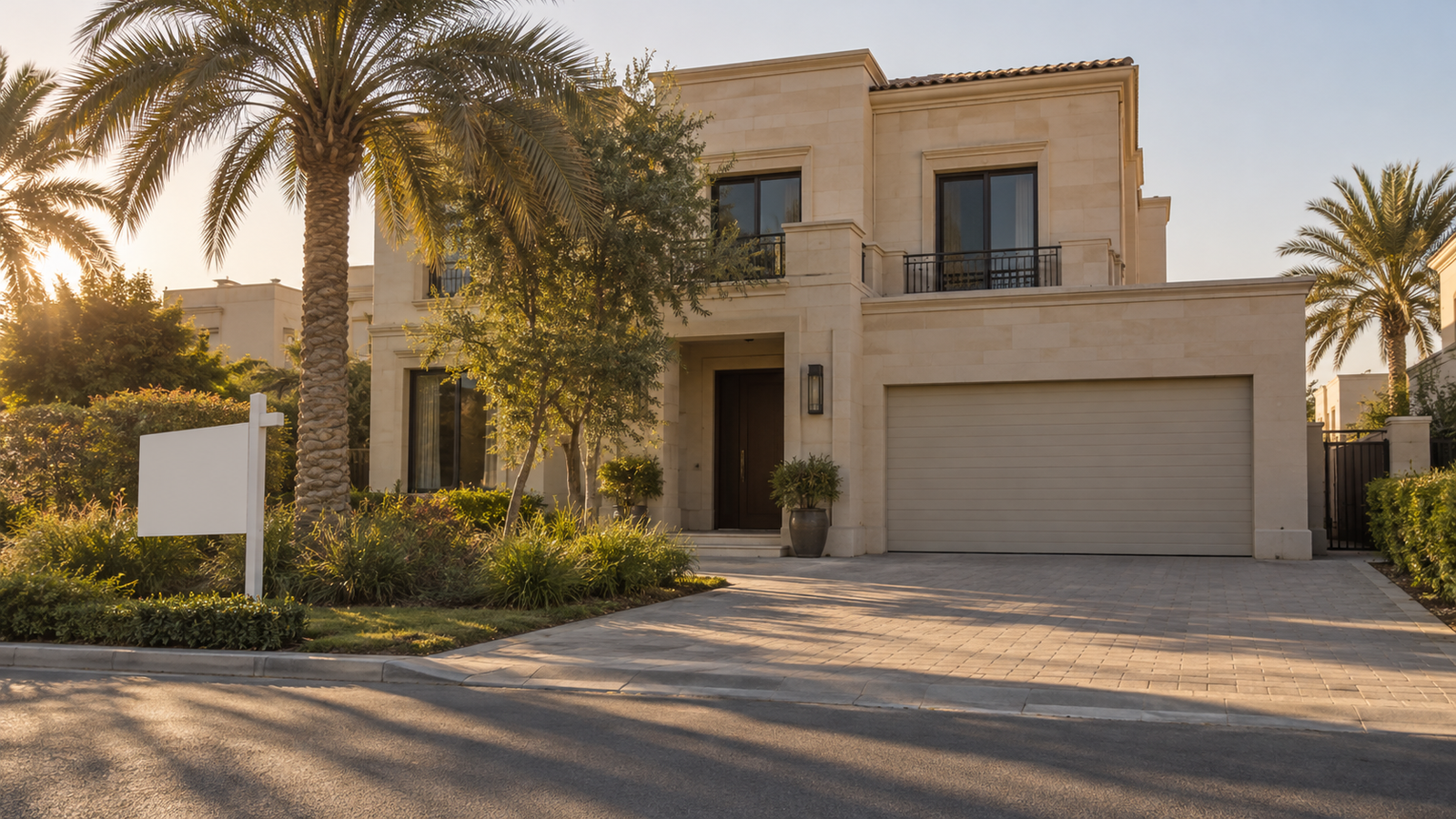
Search for distress sale of villas in Dubai and you will find hundreds of listings promising “urgent sale”, “below original price” or “motivated seller”. Some are genuine opportunities. Many are ordinary listings with a dramatic headline. A few are outright scams.
2026 is a year when real distress deals are more common than usual. Regional uncertainty, a sharp drop in transactions and a large wave of off-plan handovers have put pressure on some owners to sell. But villas remain scarcer than apartments, and genuine bargains still require research, speed and careful checks.
This guide explains what a distress sale really is in Dubai, where real deals come from, how big the discounts actually are, how to verify a deal using official data, and the red flags that should make you walk away.
Key takeaways
- “Distress sale” is not a legal category in Dubai. It is a marketing term covering motivated private sellers, off-plan contract resales, bank-consent sales and auctions.
- Genuine villa distress deals are usually 5–20% below recent comparable sales. Repossession and court auctions have historically closed around 10–30% below market.
- In 2026, the deepest discounts are concentrated in off-plan resales near handover, where investors cannot fund the final payment.
- Always compare the price with registered DLD transactions for the same community and villa type, not with the original or asking price.
- Never pay a deposit before a signed Form F (MOU), and never into a personal account.
What is a distress sale in Dubai?
A distress sale happens when an owner needs to sell quickly and accepts a price below fair market value to do so. In practice, the term is used for four quite different situations:
- Motivated private sellers. Owners relocating abroad, going through a divorce, settling an estate or needing cash for a business. They still decide whether to accept your offer.
- Off-plan contract resales (assignments). Investors who bought off-plan and can no longer afford upcoming instalments or the handover payment.
- Bank-consent or mortgage-pressure sales. Owners selling with the bank’s approval to clear a loan before arrears escalate.
- Auctions. Court-ordered sales after mortgage default, bank repossessions and voluntary auctions run through official platforms.
Only the last two involve real compulsion. In the first two, the seller is motivated but can still hold out, so the discount you get depends on negotiation and timing.
The 2026 market: why more distress deals are appearing
Dubai home prices rose more than 70% between 2020 and early 2026, and villa values grew faster than apartments. That run has slowed sharply this year:
- Regional conflict from late February 2026 made many buyers cautious.
- S&P Global Ratings estimates prices fell 5–15% between the end of 2025 and September 2026, and expects more investors to sell on the secondary market.
- Cavendish Maxwell reported that the value of home sales in Q3 2026 fell 47% year on year.
- Off-plan buyers who purchased at the peak now face handover payments in a slower market.
Even so, the picture is not one of widespread fire sales. According to LuxuryPriceDrops data covering more than 2,800 properties, only about one in ten sellers had cut their asking price since the conflict began, and the average cut was modest. S&P also expects apartment prices to fall faster than villa prices because most new supply is apartments. In other words, discounted villas exist, but they are scarcer than discounted apartments, and the strongest opportunities tend to be in off-plan units near completion.
How big are real discounts?
There is no official dataset of distress discounts in Dubai, so treat any headline percentage with caution. As a practical guide:
| Type of deal | Typical discount vs. market value | Notes |
|---|---|---|
| Motivated private seller (ready villa) | ~5–15% | Depends on urgency, condition and negotiation |
| Off-plan resale near handover | ~5–20% vs. current launch prices; sometimes below the original price | Check how much the seller has paid and what is still due |
| Bank-consent sale | ~5–15% | Seller must clear the mortgage at transfer |
| Court or repossession auction | ~10–30% historically | Cash buyers only in practice; condition and tenancy risks |
Two real 2026 examples show how this plays out. An Arabian Ranches villa was cut from AED 8.5 million to AED 7.4 million, about 13%, and still did not sell immediately. A La Mer villa was reduced from AED 110 million to AED 85 million. In both cases the reductions were significant, but repeated price cuts often mean the property started above market. A lower asking price is not the same as a below-market price.
Where to find distress sale villas in Dubai
1. Property portals
Property Finder, Bayut and Dubizzle all let you search for “distress” or “below market” listings, and some show a price-drop history. Use these as a starting point, but remember that “distress” in a headline is just a keyword the agent chose. A recent search on one major portal returned more than 250 “distressed” properties in Dubai, but only a handful were villas, and only some stated a specific price reduction.
2. Agents who specialise in a community
The best villa deals often never reach the portals. Owners who need a quick sale frequently call an agent they already know in their community. Building relationships with two or three RERA-licensed agents who specialise in the communities you want, and giving them a clear budget and proof of funds, is often the most reliable route to off-market deals.
3. Off-plan resales near handover
This is where the deepest discounts in 2026 are found. Investors who bought villas or townhouses off-plan at the peak may face a large final payment at handover, often 40–60% of the price, and choose to assign their contract instead. You take over the contract, pay the seller for what they have already paid (or less), and pay the remaining balance to the developer.
Developers must approve the transfer, and many only allow resale once a set share of the price has been paid. Always request the developer’s statement of account and confirm the remaining payment schedule.
4. Auctions
Dubai property auctions run through official channels:
- Court execution auctions for properties repossessed after mortgage default, conducted online through Emirates Auction.
- The Dubai Land Department’s eMart platform for voluntary and institutional sales.
- Bank disposals, where lenders sell repossessed homes directly before they reach court auction.
Auction supply is limited because only a small share of mortgage borrowers default long enough for their homes to be sold. When villas do appear, they can go well below market, especially in later rounds when the reserve price is reduced. But auctions come with conditions most buyers are not used to (see below).
5. Developer incentives on unsold stock
These are not distress sales in the strict sense, but in slower markets developers often offer DLD fee waivers, extended post-handover payment plans or discounts on completed unsold units. The effective price can be competitive with private resales, with less risk.
How to verify a distress deal: step by step
Step 1: Check recent transactions
Pull three to six months of registered sales for the same community, villa type and size using the Dubai Land Department website or the Dubai REST app. Adjust for differences in plot size, view, condition and upgrades. A deal is only below market if it sits clearly under that adjusted range, not just below other asking prices.
Step 2: Check the listing and the agent
- Every legitimate advert should have a valid DLD advertising permit (Trakheesi) and a Madmoun QR code that matches the unit, agency and price.
- Ask for the agent’s RERA broker card and check the agency’s licence.
Step 3: Check ownership and liabilities
- Confirm that the seller’s name matches the title deed (or the Oqood registration for off-plan).
- If someone is selling under a power of attorney, verify that it is valid and covers the sale.
- Ask for the outstanding mortgage balance and confirm how it will be cleared at transfer.
- Check for unpaid service charges, which must be settled before the developer issues an NOC.
- For off-plan: get the developer’s statement of account, confirm instalments are up to date and check the remaining payments.
Step 4: Get an independent valuation
If you are using a mortgage, the bank’s valuation is a useful reality check. A valuation at or above the agreed price supports the discount; a lower valuation is a warning sign. Cash buyers can commission an independent RICS valuation.
Step 5: Inspect the villa
Distressed sellers may have deferred maintenance. Commission a condition survey covering air-conditioning, roof and terrace waterproofing, plumbing, damp and the pool. Repair costs can quickly eat into a 10% discount.
Step 6: Use the official process
Sign a Form F (MOU) through a licensed agent before paying any deposit, keep the deposit with the agency or a trustee, and complete the transfer at a DLD registration trustee office.
Red flags: how to spot a fake distress deal
- The price is far below every registered comparable. Real distress deals are usually 5–20% below market, not 40–50%.
- “The owner is abroad and cannot meet.” Combined with pressure to pay quickly, this is a classic scam pattern.
- A deposit is requested before a signed Form F, or into a personal bank account.
- No Trakheesi permit, or a Madmoun code that does not match the property, agency or price.
- A chain of sub-agents and no one can show a RERA card.
- Vague answers about the mortgage, service charges or off-plan arrears.
- “Below original price” claims on off-plan units without a statement of account. The original price may have been paid only partly, with a large balance still due.
- Headline discounts measured against the original launch price rather than current market value.
Buying a villa at auction: what to know
Auctions can offer real discounts, but the rules are very different from a normal purchase:
- Deposit: Emirates Auction typically requires a deposit of around 20% of the property value before bidding, by manager’s cheque or bank transfer.
- Payment deadline: the balance usually has to be paid within about 10 days of the winning bid. Missing the deadline can mean losing the whole deposit.
- Cash only, in practice: the short deadline makes mortgage financing very difficult.
- Sold as seen: you may not be able to view the interior if the villa is occupied.
- Tenants: registered tenancies survive the sale. If the villa is rented, you may have to wait for the lease to end and give 12 months’ notarised notice to recover it for your own use.
- Service charge arrears: outstanding charges may pass to the buyer, so check the lot terms carefully.
- Overbidding: competition for vacant, well-located villas can push prices close to, or even above, market value.
- Fees: transfer and auction fees differ from a standard sale and are set out in each lot’s terms.
Auctions suit experienced cash buyers who can absorb condition and tenancy risks and set a firm maximum bid. Most first-time buyers are better served by negotiating with motivated sellers on the open market.
Negotiating with a motivated seller
- Find out why they are selling. Relocation dates, handover deadlines and mortgage pressure all affect how flexible the seller can be.
- Show you can close fast. Proof of funds or a mortgage pre-approval is often worth more to a distressed seller than a slightly higher offer.
- Use data, not emotion. Base your offer on registered transactions and the cost of any repairs.
- Offer flexibility on terms. A quick completion, a flexible move-out date or taking over the remaining off-plan payments can matter as much as price.
- Be ready to walk away. If the seller is not genuinely motivated, the discount will not appear.
Which villa communities see the most distress deals?
Discounted listings appear across Dubai, but they tend to cluster in three areas:
- Newly delivered off-plan communities, where many investors bought at the same time and now face handover payments, especially large master developments along Emirates Road, Dubailand and Dubai South.
- Communities with heavy upcoming supply, where buyers worry about new competition.
- The very top of the market, where a few owners of high-value villas cut prices to attract a small pool of buyers.
Established, fully built family communities with limited new supply tend to see fewer genuine distress sales, because owners there are less often forced to sell.
Total costs of buying a distress villa
A distress sale is still a normal property transaction, so the usual costs apply:
- DLD transfer fee: 4% of the price (auction lots may follow their own fee schedule)
- Registration trustee fee: about AED 4,200 plus VAT for properties above AED 500,000
- Agency commission: around 2% plus VAT (usually not charged at auction)
- Mortgage registration (0.25% of the loan), valuation and bank fees if financing
- For off-plan resales: any developer transfer or admin fee, plus the remaining instalments
- Repairs and upgrades if the villa has been poorly maintained
Factor all of these into your numbers. A 10% discount on a villa that needs AED 200,000 of work may not be a bargain at all.
Frequently asked questions
What is a distress sale villa in Dubai?
It is a villa sold by an owner who needs to sell quickly, often because of relocation, financial pressure, an off-plan payment they cannot fund or a mortgage default. The seller accepts a price below market value in exchange for a fast sale.
How much below market are distress villas in Dubai?
Genuine private distress deals are typically 5–20% below recent comparable sales. Court and repossession auctions have historically closed around 10–30% below market. Claims of 40–50% off should be treated with suspicion.
Are there more distress sales in Dubai in 2026?
Yes, more than in recent years. Transaction volumes have fallen, S&P estimates prices dropped 5–15% from the end of 2025 to September 2026, and some off-plan buyers face handover payments. However, only around one in ten sellers had cut prices, and villas remain scarcer than apartments.
Where can I find distress sale villas in Dubai?
Search property portals for distress and price-drop listings, work with RERA-licensed agents who specialise in specific communities, look at off-plan resales near handover and monitor official auctions run through Emirates Auction and the DLD’s eMart platform.
Can foreigners buy distress villas or bid at Dubai auctions?
Yes. Foreigners can buy freehold villas, including distress sales, and can register to bid at auctions with a passport. Some auction lots in non-freehold areas are restricted to UAE or GCC nationals.
Can I get a mortgage for a distress villa?
For private distress sales, yes, through the normal mortgage process. For auctions, it is very difficult because the balance usually has to be paid within around 10 days of winning.
How do I check if a distress deal is real?
Compare the price with registered DLD transactions for the same community and villa type, verify the agent’s RERA card and the listing’s Trakheesi permit and Madmoun code, confirm the seller’s name on the title deed, and check the mortgage and service charge status before paying any deposit.
What is the biggest risk with off-plan distress resales?
The biggest risk is underestimating what is still owed to the developer. A contract offered “below the original price” may still require a large handover payment. Always get the developer’s statement of account and confirm the developer will approve the transfer.
Data sources: TruHauz distress-sale guide (October 2026), citing S&P Global Ratings, Cavendish Maxwell, AGBI and LuxuryPriceDrops data; Real Estate Club Dubai auction guide (June 2026); Property Finder distressed property listings (October 2026); Cavendish Maxwell Q3 2026 data via The National. Discount ranges are indicative and based on market observations, not an official dataset.
Disclaimer: This article is for general information only and does not constitute legal, financial, tax or real estate advice, and nothing in it is an offer or recommendation to buy any specific property. Property prices, discounts, auction rules, fees and regulations in Dubai change frequently, and the figures above are indicative ranges and examples compiled from third-party sources that we do not control or guarantee. Examples of listings and price reductions are for illustration only. While we aim to keep this information accurate and up to date, it may contain errors or omissions. Always verify ownership, liabilities, prices and rules with the Dubai Land Department (DLD), RERA, the developer, your bank, a licensed real estate professional or a qualified lawyer before signing any agreement, bidding at auction or making any payment. We accept no liability for any loss arising from reliance on this content.